The Evolution of Dieting: Why Fast Calorie Tracking is a Game Changer
For decades, the foundation of successful weight loss and muscle gain has been rooted in a simple scientific principle: energy balance. If you want to lose weight, you need to be in a calorie deficit. If you want to build muscle, a slight surplus is required. However, while the science is straightforward, the execution has historically been anything but.
Anyone who has tried traditional calorie counting knows the struggle. You cook a meal, pull out your digital scale, weigh every single ingredient, open an app, search through a cluttered database of thousands of slightly different entries, and manually input the data. This tedious process is one of the primary reasons people abandon their diets. But what if you could achieve accurate results without the hassle? Welcome to the era of fast calorie tracking powered by Artificial Intelligence.
Today, AI is revolutionizing how we interact with our nutrition. With apps like MacroLog, logging a complex meal has gone from a five-minute chore to a five-second breeze. Let's explore how AI is making calorie tracking effortless, accurate, and sustainable for the long term.
Why Traditional Calorie Tracking Fails Most People
Before diving into the AI revolution, we need to understand why the old methods are fundamentally flawed for the average person.
1. The Time Burden
When you are busy with work, family, and daily responsibilities, spending 20 to 30 minutes a day logging food is a massive barrier. Over a month, that's nearly 15 hours spent just staring at a database. This friction leads to "database fatigue," where users either guess their portions wildly or stop tracking altogether. If you want to understand the basics of tracking properly, check out our guide on How to Count Calories: The Complete Beginner's Guide.
2. Human Error and Cluttered Databases
Traditional apps rely on user-generated databases. If you search for an apple, you might find 50 different entries ranging from 50 to 150 calories. Choosing the wrong entry consistently is a primary reason Why Your Calorie Count Is Wrong (And How to Fix It).
3. The Psychological Toll
Constantly obsessing over barcodes and exact gram measurements can lead to an unhealthy relationship with food. It turns eating into a math equation rather than an enjoyable human experience. Transitioning to AI-assisted tracking is a fantastic way to learn How to Track Calories Without Becoming Obsessive: A Guide to Healthy Calorie Tracking.
How AI Enables Fast Calorie Tracking
Artificial Intelligence bridges the gap between the accuracy of strict weighing and the freedom of intuitive eating. Here is how modern technology, specifically through platforms like MacroLog, is changing the landscape.
Photo Recognition: Snap and Go
Imagine sitting down at a restaurant. Instead of deconstructing your meal into individual ingredients to log them, you simply take a picture. AI computer vision algorithms analyze the image, identify the food items, estimate the portion sizes based on visual context, and instantly calculate the calories and macronutrients.
This is not science fiction; it is what MacroLog does every day. Whether it's a mixed salad, a steak with sweet potatoes, or a complex pasta dish, the AI breaks down the visual data in milliseconds. This feature alone defines fast calorie tracking.
Voice Logging: Talk to Your Tracker
Natural Language Processing (NLP) is another massive leap forward. Sometimes you don't have a picture, or you've already eaten the meal. Instead of typing, you can just use your voice. By simply saying, "I had a bowl of oatmeal with a tablespoon of peanut butter, a sliced banana, and a scoop of whey protein," the AI parses the sentence, understands the context, matches the foods to verified nutritional data, and logs the entire meal instantly.
Smart Barcode Scanning
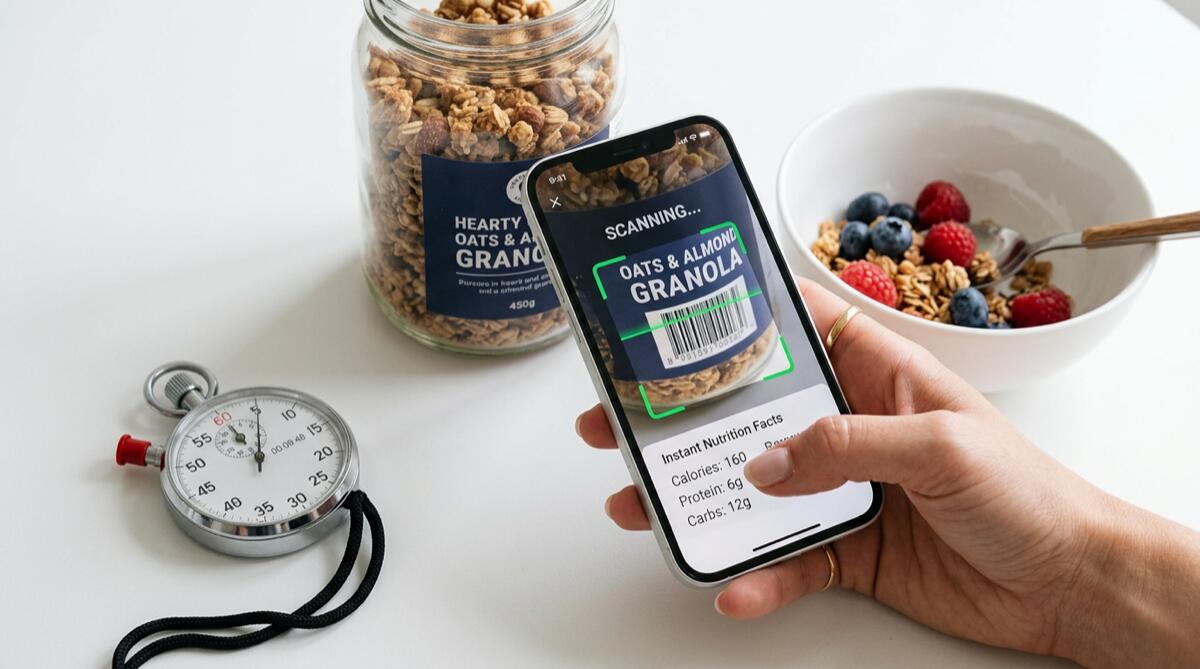
While barcode scanning isn't new, AI enhances it by instantly cross-referencing global databases to ensure the nutritional information is accurate and up-to-date, eliminating the user-generated errors that plague older apps. It makes figuring out What Are Macros? The Complete Guide to Macronutrients incredibly simple when dealing with packaged foods.
The Science of Adherence: Why Speed Matters
In the realm of nutritional science, there is a well-known maxim: The best diet is the one you can stick to. Adherence is the undisputed king of weight loss.
Studies consistently show that the harder a habit is to maintain, the faster people will abandon it. By reducing the friction of meal logging, AI directly improves diet adherence. When tracking takes seconds, you are far more likely to log that quick snack or weekend meal out, which are often the hidden calories that stall progress. This consistency is crucial when learning Calorie Tracking for Weight Loss: The Science-Based Approach.
Furthermore, consistent tracking helps you maintain a proper energy balance. If you are unsure about how this balance works, our comprehensive guide on What Is a Calorie Deficit and How Does It Work? breaks down the exact science.
Step-by-Step: Optimizing Your Diet with AI
Ready to embrace the future of nutrition? Here is how to combine AI technology with solid nutritional science to reach your goals.
Step 1: Determine Your Energy Needs
Before you start tracking, you need a target. Your Total Daily Energy Expenditure (TDEE) is the number of calories you burn in a day. You can learn exactly how to find this number in our article: TDEE Explained: How to Use a TDEE Calculator for Weight Loss. It's also important to understand the baseline of your metabolism, which you can read about in BMR vs TDEE: What's the Difference and Why It Matters.
Step 2: Set Your Macronutrient Goals
Once you have your calorie target, you need to divide it into proteins, fats, and carbohydrates. For instance, understanding How Much Fat Should You Eat Per Day? is vital for hormonal health. For a complete walkthrough, check out How to Count Macros: A Step-by-Step Guide.
Step 3: Let MacroLog Do the Heavy Lifting
With your targets set, download MacroLog. For your next meal, simply snap a photo. If you are eating something you prepared from a complex family recipe, use the voice logging feature to quickly list the ingredients. The AI will instantly align your meal with your daily targets.
Step 4: Review and Adjust
Over time, you might wonder, How Long Should You Track Calories? The Complete Timeline. The beauty of AI tracking is that it educates you as you go. By constantly seeing accurate portion sizes and macro breakdowns, you naturally develop a better intuition for food. Many users eventually find a perfect balance, which we discuss in Calorie Counting vs Intuitive Eating: Which Is Right for You?.
The Bottom Line: Do Calories Still Matter?
With all this talk about AI and technology, it's easy to lose sight of the fundamentals. Do Calories Really Matter? The Science of Energy Balance overwhelmingly says yes. You cannot outsmart thermodynamics. However, you can outsmart the tedious process of tracking them.
Fast calorie tracking is not just a convenience; it is a paradigm shift in nutritional adherence. By removing the barriers of time, frustration, and inaccuracy, AI empowers you to focus on what truly matters: making healthy choices, enjoying your food, and living your life.
Ready to experience the future of dieting? Stop typing and start snapping. Download MacroLog today and transform the way you track your nutrition forever!


