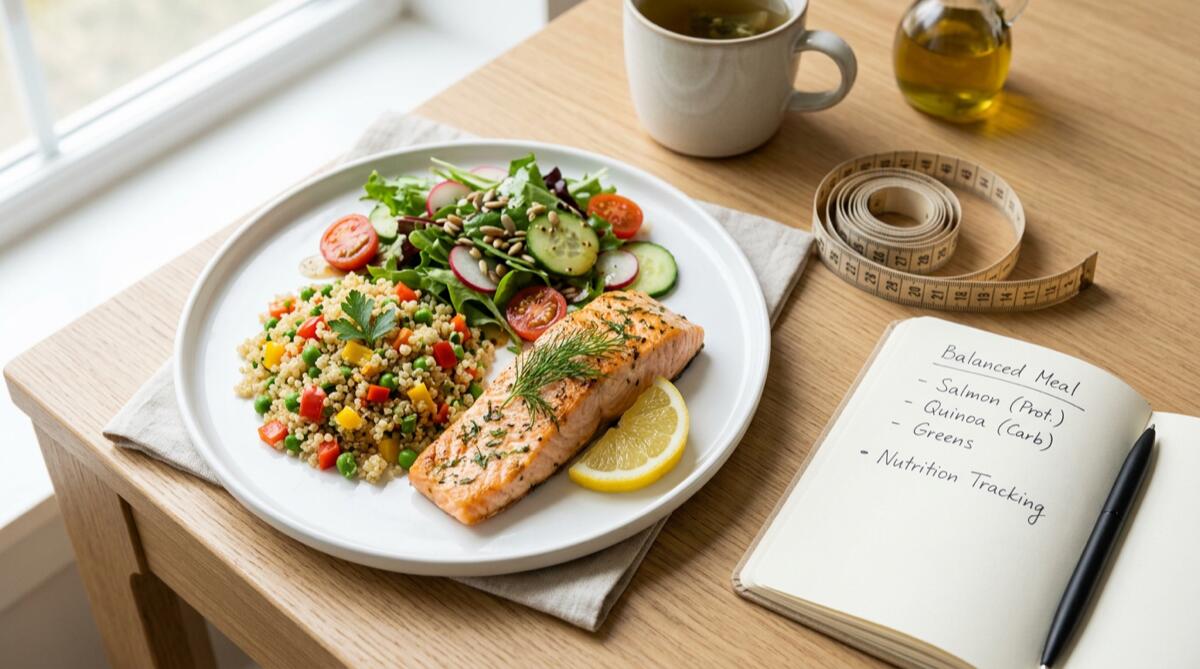
The Ultimate Guide to Calorie Tracking
Whether your goal is to lose stubborn body fat, build lean muscle, or simply maintain a healthy lifestyle, understanding energy balance is the most critical piece of the puzzle. If you have ever wondered how to count calories effectively without feeling overwhelmed, you are in the right place. This comprehensive guide will walk you through the science of calorie tracking, practical steps to get started, and how modern AI tools can make the process completely frictionless.
Why You Should Learn How to Count Calories
Calorie counting is often misunderstood. It is not about obsessive restriction; it is about awareness. Studies published in the Journal of Medical Internet Research consistently show that individuals who track their food intake are significantly more successful at losing weight and keeping it off compared to those who do not.
The Science of Energy Balance
At its core, weight management is dictated by the laws of thermodynamics. A calorie is simply a unit of energy. Your body burns a specific amount of energy every day just to keep you alive and moving. This is known as your Total Daily Energy Expenditure (TDEE). The golden rule of weight management is straightforward:
- Calorie Deficit: Consuming fewer calories than your TDEE leads to weight loss.
- Calorie Maintenance: Consuming the exact amount of calories as your TDEE maintains your current weight.
- Calorie Surplus: Consuming more calories than your TDEE leads to weight gain (fat or muscle, depending on your training).
Awareness Over Restriction
Learning how to count calories gives you the freedom to eat the foods you love. No single food inherently causes weight gain. You can still enjoy a slice of pizza or a piece of chocolate, provided it fits within your daily calorie and macronutrient goals. Tracking removes the guilt associated with eating "bad" foods and replaces it with data-driven empowerment.
How to Calculate Your Calorie Needs
Before you start tracking, you need a target. Here is how to find yours.
1. Calculate Your Basal Metabolic Rate (BMR)
Your BMR is the number of calories your body burns at rest. The most accurate formula widely used today is the Mifflin-St Jeor equation. While you can calculate this manually, most modern calorie trackers will do this for you based on your age, gender, weight, and height.
2. Determine Your Total Daily Energy Expenditure (TDEE)
To find your TDEE, you multiply your BMR by an activity multiplier (ranging from 1.2 for sedentary individuals to 1.9 for highly active athletes). This accounts for Non-Exercise Activity Thermogenesis (NEAT), the Thermic Effect of Food (TEF), and your actual workouts.
3. Set Your Goal
If you want to lose weight, a standard safe deficit is 500 calories below your TDEE, which generally results in about 1 pound of fat loss per week. If you want to build muscle, aim for a slight surplus of 200-300 calories.
Step-by-Step Guide: How to Count Calories Successfully
Step 1: Get a Digital Food Scale
If there is one non-negotiable rule when learning how to count calories, it is this: ditch the measuring cups and buy a digital food scale. Volume measurements (like "one cup of cereal" or "a tablespoon of peanut butter") are notoriously inaccurate. A "heaping tablespoon" of peanut butter can easily pack an extra 100 calories that you didn't account for. Always weigh your food in grams or ounces.
Step 2: Weigh Food Raw, Not Cooked
Meat shrinks when cooked because it loses water, while grains like rice and pasta expand because they absorb water. A 100g serving of raw chicken breast has different macros than 100g of cooked chicken breast. To ensure maximum accuracy, always weigh your ingredients in their raw, uncooked state.
Step 3: Read Nutrition Labels Carefully
Pay close attention to the "Serving Size" and "Servings Per Container" on nutrition labels. A common trap is assuming a small bottle of juice or a single packaged pastry is one serving, when the label actually states it contains two or three servings. Multiply the calories and macros by the number of servings you actually consume.
Step 4: Track Everything (Even the Little Things)
Those "invisible" calories add up fast. Cooking oils, butter, salad dressings, and sauces are incredibly calorie-dense. Just one tablespoon of olive oil contains 120 calories. If you pour oil into a pan without measuring it, you could accidentally add 300-400 calories to an otherwise healthy meal.
Common Mistakes to Avoid
Even seasoned trackers can fall into traps. Here are the most common pitfalls:
- Forgetting Liquid Calories: Sodas, sugary coffees, fruit juices, and alcohol contain significant calories but do little to keep you full. Always log your beverages.
- The "Bite, Lick, and Taste" Habit: Taking a bite of your partner's meal or finishing your child's leftovers might seem harmless, but those unlogged calories can easily erase a 500-calorie deficit.
- Underestimating Weekend Eating: Being perfectly on track from Monday to Friday, only to completely ignore your tracking on Saturday and Sunday, can ruin your weekly average.
Make Tracking Effortless with MacroLog
Historically, learning how to count calories meant tedious manual entry, searching through massive databases, and guessing portion sizes. That is no longer the case. MacroLog is a next-generation, AI-powered calorie tracker designed to make logging your meals entirely frictionless.
AI Photo Recognition
Tired of searching for every individual ingredient in your salad? With MacroLog, you simply snap a photo of your meal. The advanced AI analyzes the image, identifies the foods, estimates the portion sizes, and logs the calories and macros for you instantly.
Voice Logging
Cooking with messy hands? Just use MacroLog's voice logging feature. Simply say, "I just ate 150 grams of grilled salmon with a cup of jasmine rice and 100 grams of broccoli," and the app will parse your natural language and log it accurately.
Barcode Scanner
For packaged foods, MacroLog features a lightning-fast barcode scanner. Scan the item, and the exact nutritional information is instantly added to your daily diary.
Conclusion
Mastering how to count calories is a superpower. It removes the guesswork from dieting and puts you in complete control of your body composition. Start by calculating your TDEE, invest in a food scale, and be honest with your tracking.
Ready to take the hassle out of calorie tracking? Download MacroLog today and let AI do the heavy lifting for you.
Get MacroLog now:
Download on the Apple App Store (iOS)
Get it on Google Play (Android)