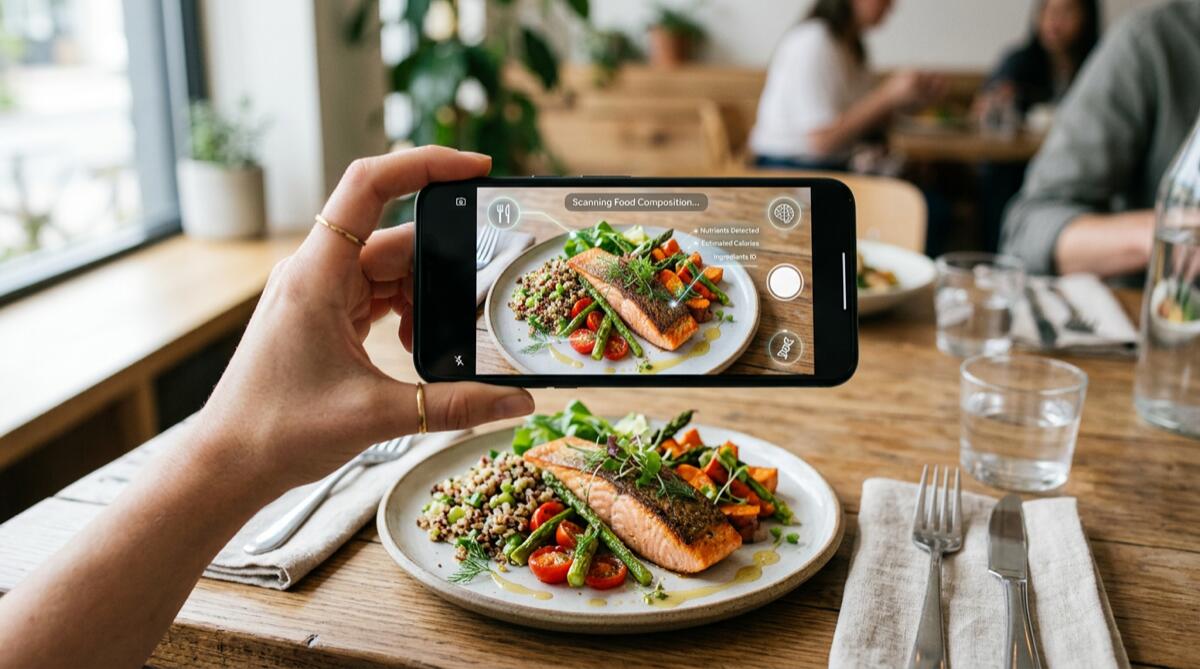
Have you ever stared at a delicious plate of food, phone in hand, feeling the familiar dread of having to manually search, estimate, and log every single ingredient before you can take a bite? If you've ever tried keeping a food diary, you know that manual logging is often the biggest hurdle to long-term dietary success. Enter AI food recognition—a groundbreaking technology that is fundamentally changing how we approach nutrition.
Instead of typing "grilled chicken breast," "mixed greens," and "olive oil dressing" into a search bar, modern technology allows you to simply snap a photo or speak into your phone. But how does this seemingly magical process actually work? In this comprehensive guide, we'll dive deep into the science behind AI food recognition, why it's making traditional tracking obsolete, and how it can help you reach your fitness goals with zero friction.
What is AI Food Recognition?
At its core, AI food recognition is a specialized application of computer vision and machine learning designed to identify food items, estimate portion sizes, and calculate nutritional information from visual or audio data. It bridges the gap between the physical meal on your plate and the digital data required to track your macros and calories.
While early attempts at food tracking apps relied entirely on user-generated databases and manual entry, AI-driven platforms use complex algorithms trained on millions of food images to instantly recognize what you're about to eat. It's like having a digital nutritionist in your pocket, instantly analyzing your meals.
The Science: How Does AI Actually "See" Your Food?
When you point your camera at a meal, the app doesn't just see a picture; it processes a complex grid of pixels. The journey from a simple photo to a detailed macro breakdown involves several sophisticated technological steps.
1. Computer Vision and Image Segmentation
The first step in AI food recognition is separating the food from the background. Using a process called image segmentation, the AI identifies the boundaries of the plate, the table, and the distinct food items. If you have a steak with a side of asparagus and mashed potatoes, the algorithm draws invisible "bounding boxes" around each distinct element, isolating them for individual analysis.
2. Convolutional Neural Networks (CNNs)
Once the food items are isolated, the app uses Convolutional Neural Networks (CNNs). CNNs are deep learning models specifically designed to analyze visual imagery. These networks have been trained on massive datasets containing millions of photos of food from different angles, in different lighting, and in various states of preparation.
The CNN looks for specific patterns: the texture of the steak crust, the specific shade of green and structural shape of the asparagus, and the smooth consistency of the mashed potatoes. By comparing these visual features against its vast database, the AI can classify the food with remarkable accuracy.
3. Portion Size Estimation and Depth Mapping
Identifying the food is only half the battle; knowing how much food is there is crucial for accurate calorie tracking. To solve this, advanced AI food recognition systems use relative sizing and depth estimation. By analyzing the size of the food relative to standard objects (like a fork, a plate, or even using the smartphone's built-in depth sensors), the AI calculates the volume of the food. This volume is then cross-referenced with the known density of the identified food to estimate its weight.
Why Traditional Calorie Tracking is Changing
For decades, the standard approach to weight loss or muscle gain was manual tracking. While effective, it is notoriously tedious. If you've ever wondered Why Your Calorie Count Is Wrong (And How to Fix It), human error is usually the primary culprit. We tend to underestimate portion sizes, forget to log cooking oils, and get fatigued by the constant data entry.
AI food recognition removes the friction. By automating the hardest parts of tracking, it allows users to focus on what actually matters: making healthy choices and enjoying their food. If you are just starting your journey, combining AI tools with the fundamentals outlined in How to Count Calories: The Complete Beginner's Guide is a recipe for guaranteed success.
The Benefits of Using AI Food Recognition
Switching to an AI-powered tracking method offers profound benefits that go beyond just saving time.
Unmatched Speed and Convenience
What used to take three to five minutes per meal now takes three seconds. Over the course of a day, that's 15-20 minutes saved. Over a year, you're saving hundreds of hours. This convenience is the number one reason why users of AI trackers are significantly more likely to stick to their diets long-term.
Reducing Dietary Obsession
Manual tracking requires hyper-focus on numbers, scales, and barcodes, which can sometimes lead to an unhealthy relationship with food. AI tracking promotes a more mindful approach. You snap a photo, get your data, and move on. For more on this balanced approach, read our guide on How to Track Calories Without Becoming Obsessive: A Guide to Healthy Calorie Tracking.
Better Handling of Complex Meals
Understanding What Are Macros? The Complete Guide to Macronutrients is easy in theory, but hard in practice when dealing with mixed meals like casseroles, stews, or salads. AI models are exceptionally good at breaking down mixed dishes into their constituent parts, estimating the ratios of proteins, fats, and carbs much faster than a human could.
How MacroLog Leverages AI Food Recognition
If you want to experience the cutting edge of this technology, MacroLog is leading the charge. MacroLog isn't just a database; it's a comprehensive AI nutrition assistant designed to make tracking completely effortless.
- Photo Recognition: Simply snap a picture of your plate. MacroLog's advanced computer vision instantly identifies the foods, estimates the portion sizes, and logs the calories and macros.
- Voice Logging: Don't want to take a picture? Just tell the app what you ate. By saying, "I had a bowl of oatmeal with a tablespoon of peanut butter and half a banana," MacroLog's Natural Language Processing (NLP) instantly parses your speech and logs the exact ingredients.
- Smart Barcode Scanning: For packaged foods, MacroLog features lightning-fast barcode scanning that instantly pulls verified nutritional data from a massive global database.
By combining these three AI modalities, MacroLog ensures that no matter what you're eating or where you are, you can log it accurately in seconds.
Tips for Getting the Best Results with AI Food Logging
While AI food recognition is incredibly powerful, it's still a developing technology. Here are a few tips to ensure you get the most accurate readings possible:
- Ensure Good Lighting: AI relies on visual details. Taking a photo in a well-lit environment helps the CNN accurately identify textures and colors. Natural daylight is best.
- Avoid Extreme Angles: Shoot your food from a slight angle (around 45 degrees) rather than directly top-down. This helps the AI gauge the depth and volume of the food for better portion estimation.
- Separate Your Food: If possible, avoid piling food on top of each other. If the AI can clearly see the chicken, the rice, and the broccoli as separate items, the macro breakdown will be much more precise. This is especially important when you are learning How to Count Macros: A Step-by-Step Guide.
- Use Context for Hidden Ingredients: AI can't see the butter cooked into your steak or the sugar hidden in your sauce. Use voice logging alongside photo logging to add context: "Snap a photo + 'cooked in one tablespoon of olive oil'."
The Future of AI in Nutrition
We are only scratching the surface of what AI can do for human health. As algorithms become more sophisticated and smartphone cameras integrate better depth-sensing technology, the accuracy of AI food recognition will soon surpass even the most meticulous human tracking.
Ultimately, the goal of technology is to make our lives easier. If you want to know Do Calories Really Matter? The Science of Energy Balance, the scientific consensus is a resounding yes. But how you track those calories shouldn't be a burden.
Ready to ditch the manual entry, the kitchen scales, and the guesswork? Experience the future of nutrition tracking today. Download MacroLog and let AI do the heavy lifting for your diet.


