The Great Fat Debate: Friend or Foe?
If you grew up in the 1980s or 90s, you probably remember the low-fat craze. Grocery store shelves were packed with fat-free cookies, skim milk, and low-fat yogurts loaded with sugar to make up for the lack of taste. Fast forward to today, and the pendulum has swung completely in the opposite direction with the rise of the ketogenic diet, where people are putting butter in their coffee and eating bacon by the pound.
So, where does the truth lie? If you are trying to optimize your health, lose weight, or build muscle, you are likely asking yourself: how much fat per day should I actually be eating?
The short answer is that dietary fat is absolutely essential for your survival, hormone production, and overall well-being. But like all macronutrients, balance is key. In this comprehensive guide, we will break down exactly how to calculate your daily fat intake, the types of fats you should focus on, and how to track them effortlessly.
Why Your Body Needs Dietary Fat
Before we calculate the numbers, it is crucial to understand why fat is not the enemy. To learn more about how fat fits into the bigger picture of your diet, check out our guide on .
1. Hormone Production and Regulation
Dietary fat, particularly cholesterol and saturated fat, is the building block for crucial hormones in your body. This includes sex hormones like testosterone and estrogen. If your fat intake drops too low for an extended period, you may experience a drop in libido, disrupted menstrual cycles, and a decrease in muscle-building potential.
2. Vitamin Absorption
Vitamins A, D, E, and K are fat-soluble. This means your body cannot absorb or utilize them without the presence of dietary fat. Eating a giant spinach salad is great, but if you use a fat-free dressing, you are missing out on a massive portion of the nutritional benefits. Adding just a little olive oil or avocado ensures you absorb these vital nutrients.
3. Brain Health and Cell Function
Your brain is composed of nearly 60% fat. Omega-3 fatty acids, in particular, are critical for cognitive function, memory, and protecting against neurodegenerative diseases. Furthermore, every single cell membrane in your body is made of a lipid (fat) bilayer that controls what enters and exits the cell.
How Much Fat Per Day? The Official Guidelines
The Acceptable Macronutrient Distribution Range (AMDR) established by health authorities suggests that adults should consume between 20% and 35% of their total daily calories from fat.
Because fat is more calorie-dense than protein and carbohydrates—providing 9 calories per gram compared to their 4 calories per gram—these calories can add up quickly. If you aren't sure how many total calories you need in the first place, we highly recommend reading and understanding your baseline by having .
Calculating Your Daily Fat Intake Based on Your Goals
While the percentage rule (20-35%) is a great starting point, many nutrition experts prefer calculating fat based on your body weight. A generally accepted minimum threshold for hormonal health is 0.3 to 0.4 grams of fat per pound of body weight (or about 0.8 to 1 gram per kilogram).
Let's look at how your specific fitness goals might alter how much fat per day you should consume.
1. Fat Intake for Weight Loss
When you are trying to lose weight, you must be in a calorie deficit. You can learn exactly how to set this up in our article:
Because you have fewer total calories to work with, and you need to keep protein high to preserve muscle mass, fat intake often needs to be moderated. For weight loss, aiming for 0.3 to 0.45 grams per pound of body weight is typically the sweet spot. This provides enough fat for hormone health while leaving enough room in your calorie budget for filling carbohydrates and muscle-sparing protein.
2. Fat Intake for Muscle Gain
If your goal is to build muscle, you will be eating in a calorie surplus. With more calories available, you can afford to eat more fat. A higher fat intake can make it much easier to hit your calorie goals because fat is so calorie-dense. For muscle gain, aiming for 0.4 to 0.6 grams per pound of body weight (or roughly 25-30% of your total calories) is ideal.
3. Fat Intake for Maintenance
If you are happy with your current weight and just want to maintain your physique and support your health, sitting comfortably in the middle of the AMDR range is perfect. Aim for 0.4 to 0.5 grams per pound, or roughly 25-30% of your total daily energy expenditure.
If you want a deeper dive into setting up all your macros, read .
Not All Fats Are Created Equal: Types of Dietary Fat
Knowing how much fat per day to eat is only half the battle; the quality of that fat matters immensely for your cardiovascular health and inflammation levels.
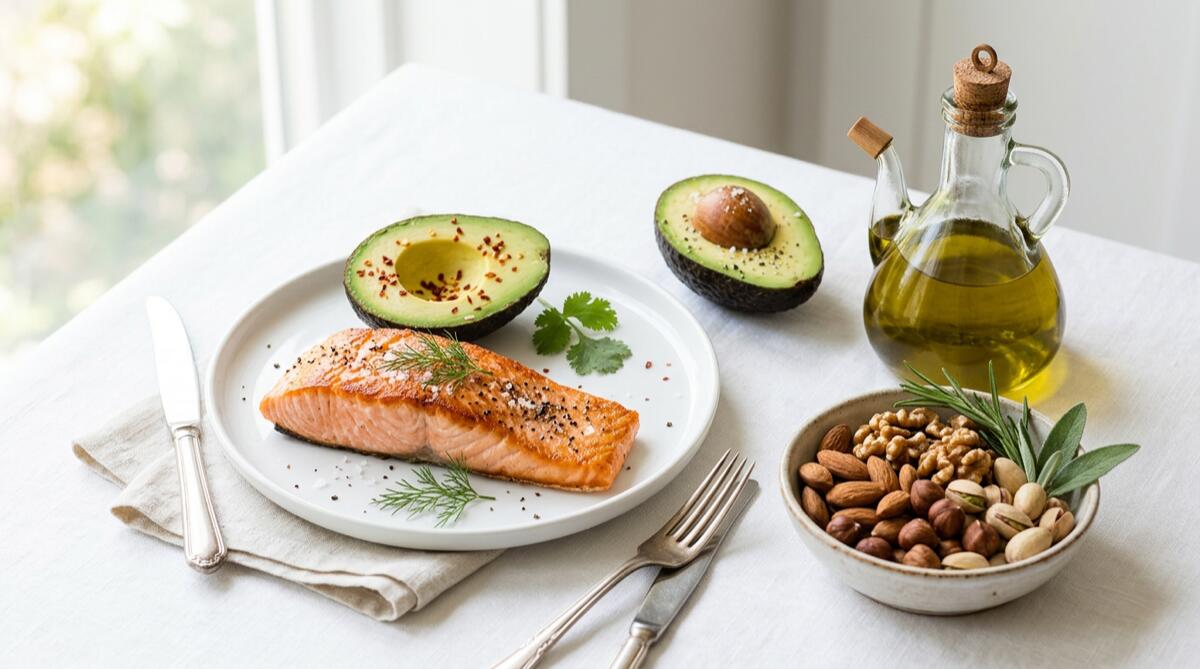
- Monounsaturated Fats (The Good): Found in olive oil, avocados, almonds, and peanuts. These are heart-healthy fats that help reduce bad cholesterol levels. They should make up the bulk of your fat intake.
- Polyunsaturated Fats (The Essential): Found in fatty fish (salmon, mackerel), walnuts, flaxseeds, and chia seeds. This category includes Omega-3 and Omega-6 fatty acids. Your body cannot produce these, so you must get them from food.
- Saturated Fats (The Controversial): Found in butter, cheese, fatty meats, and coconut oil. While no longer completely demonized, health guidelines still suggest limiting saturated fats to less than 10% of your total daily calories to support heart health.
- Trans Fats (The Ugly): Found in partially hydrogenated oils, some margarines, and highly processed baked goods. You should aim to keep trans fats as close to zero as possible, as they actively raise bad cholesterol and lower good cholesterol.
How to Track Your Fat Intake Easily
Tracking macros can feel overwhelming, especially when you are trying to balance fats, carbs, and proteins. But it doesn't have to be a chore.
The easiest way to ensure you are hitting your fat targets is by using a smart tracking tool. This is where MacroLog comes in. Instead of manually searching databases for the exact nutritional profile of your avocado toast or salmon fillet, MacroLog uses advanced AI to do the heavy lifting.
You can simply snap a photo of your meal, use the voice logging feature to say "I had two scrambled eggs cooked in a tablespoon of butter," or scan the barcode of your peanut butter jar. The app instantly calculates the calories and macros, showing you exactly how much fat you've consumed and how much you have left for the day.
Signs You Are Not Eating Enough Fat
Sometimes, in an effort to lose weight quickly, people drop their fat intake too low. If you experience any of the following symptoms, it might be time to recalculate your macros:
- Constant Hunger: Fat slows down digestion and promotes satiety. Without it, you might feel ravenous an hour after eating.
- Dry Skin and Brittle Hair: Fat is essential for maintaining healthy, lubricated skin and strong hair follicles.
- Brain Fog: A lack of essential fatty acids can leave you feeling unfocused and mentally fatigued.
- Joint Pain: Healthy fats, particularly Omega-3s, help lubricate joints and reduce systemic inflammation.
If you suspect your calorie or macro targets are off, read our guide on Why Your Calorie Count Is Wrong (And How to Fix It).
Conclusion
So, how much fat per day should you eat? The answer depends on your total calorie needs, your body weight, and your fitness goals. However, a safe and healthy baseline for most people is between 20% and 35% of total daily calories, ensuring you get at least 0.3 grams per pound of body weight to support essential bodily functions.
Remember that the quality of your fat is just as important as the quantity. Prioritize whole-food sources like olive oil, nuts, avocados, and fatty fish, while keeping processed trans fats off your plate.
Ready to take the guesswork out of your nutrition? Start tracking your daily fat intake the easy way. Download MacroLog today and let AI simplify your macro tracking journey with photo recognition and voice logging!
