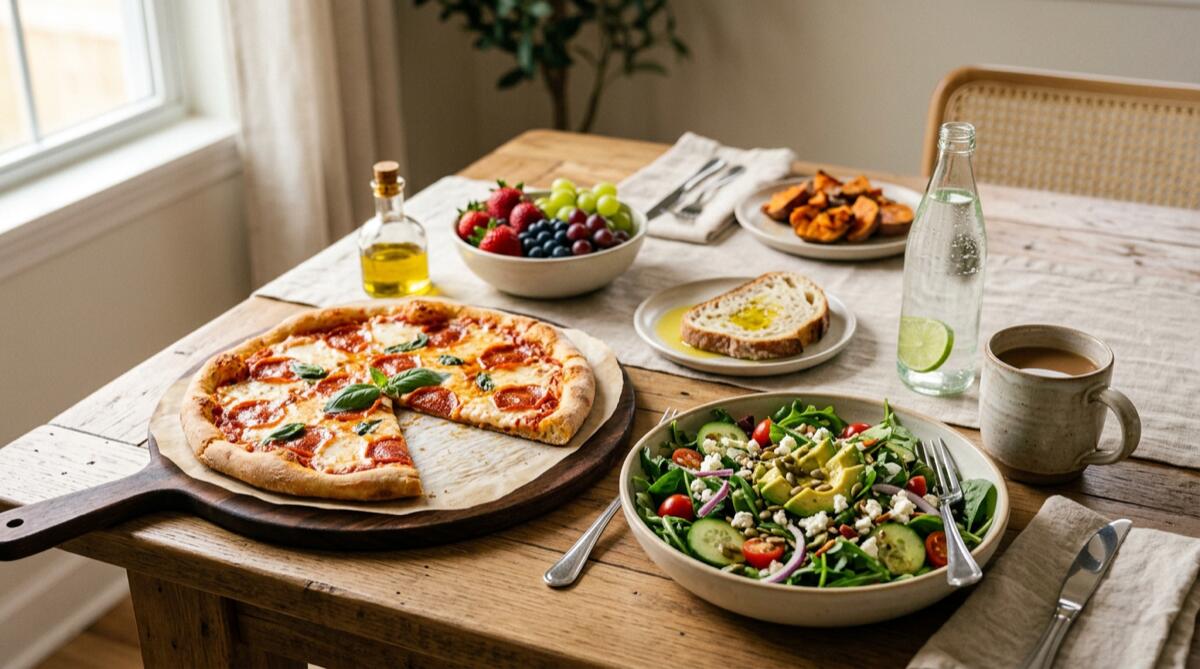
For decades, the fitness industry promoted a rigid approach to weight loss: eat "clean" foods, avoid "dirty" foods, and suffer through bland meals of boiled chicken and broccoli. Fortunately, science has evolved, bringing us a much more sustainable approach: IIFYM flexible dieting. If you are tired of restrictive diets that ban your favorite foods, this complete guide will show you how to achieve your dream body while still enjoying pizza, chocolate, and ice cream.
What is IIFYM Flexible Dieting?
IIFYM stands for "If It Fits Your Macros." At its core, IIFYM flexible dieting is a nutritional strategy that focuses on meeting daily macronutrient targets—protein, carbohydrates, and fats—rather than restricting specific food groups. The philosophy is simple: there are no inherently "good" or "bad" foods. As long as a food fits into your daily macronutrient and calorie goals, you can eat it and still lose weight, build muscle, or maintain your current physique.
To fully grasp this concept, it is essential to understand what macros are. Every food you consume is made up of these building blocks, and your body utilizes them for energy, muscle repair, and hormone regulation.
The Science Behind Flexible Dieting
The reason IIFYM flexible dieting works so effectively is rooted in the laws of thermodynamics. Weight loss is fundamentally driven by a calorie deficit. If you consume fewer calories than your body burns, you will lose weight, regardless of whether those calories come from a kale salad or a donut.
However, body composition—how much muscle versus fat you have—is dictated by your macronutrient intake. This is why calories really matter for weight, but macros matter for how you look and feel. Your digestive system breaks down carbohydrates into glucose, whether that carb came from a sweet potato or a candy bar. While the sweet potato provides more vitamins and fiber, the pure energy value (calories) is processed similarly by your body.
How to Start IIFYM Flexible Dieting in 4 Steps
Step 1: Calculate Your Total Daily Energy Expenditure (TDEE)
Before you can set your macros, you need to know how many calories your body burns in a day. Your TDEE includes your Basal Metabolic Rate (BMR) plus the energy you expend through daily movement and exercise. Understanding the difference between BMR and TDEE is crucial. We highly recommend using the Mifflin-St Jeor equation to find your baseline, as it is widely considered the most accurate formula available.
If you need a step-by-step walkthrough on finding this number, check out our guide on how to use a TDEE calculator.
Step 2: Determine Your Calorie Goal
Once you have your TDEE, you must adjust it based on your goal:
- Weight Loss: Subtract 300-500 calories from your TDEE.
- Maintenance: Keep calories equal to your TDEE.
- Muscle Gain: Add 200-300 calories to your TDEE.
If you are unsure where to start, our comprehensive guide on how many calories you should eat per day will help you pinpoint the exact number.
Step 3: Set Your Macronutrient Targets
Now comes the "macros" part of IIFYM. You need to divide your daily calorie allowance into protein, fats, and carbohydrates. Here is a standard breakdown:
- Protein: Aim for 0.8 to 1.2 grams of protein per pound of body weight. Protein has 4 calories per gram.
- Fats: Allocate 20-30% of your total calories to fats. Fats have 9 calories per gram. If you're wondering about the exact amount, read our guide on how much fat you should eat per day.
- Carbohydrates: Fill the remaining calories with carbs. Carbs have 4 calories per gram.
For a more detailed breakdown, read our step-by-step guide on how to count macros.
Step 4: Start Tracking Your Food
To succeed with IIFYM flexible dieting, accurate tracking is non-negotiable. This is where many beginners feel overwhelmed, but it doesn't have to be difficult. Learning how to count calories efficiently is a game-changer.
Instead of manually searching for foods and guessing portion sizes, you can use MacroLog. As an AI-powered calorie tracker, MacroLog allows you to log meals instantly using photo recognition, voice logging, and barcode scanning. You just snap a picture of your plate or tell the app what you ate, and the AI calculates the macros for you. It removes the friction from tracking, making IIFYM effortless.
The 80/20 Rule: The Secret to Healthy Flexible Dieting
The biggest misconception about IIFYM flexible dieting is that it encourages a diet consisting entirely of junk food. While you could theoretically lose weight eating only Pop-Tarts and protein shakes, you would feel terrible, lack energy, and miss out on vital micronutrients.
The most successful approach to IIFYM is the 80/20 Rule:
- 80% of your calories should come from whole, nutrient-dense foods (lean meats, vegetables, fruits, whole grains).
- 20% of your calories can be reserved for "fun" foods or treats (chocolate, a slice of pizza, ice cream).
This balance provides the vitamins, minerals, and fiber your body needs for optimal health, while simultaneously satisfying your cravings and preventing binge eating. It is the key to learning how to track calories without becoming obsessive.
Common Mistakes in IIFYM Flexible Dieting
While flexible dieting is incredibly freeing, there are a few pitfalls to avoid:
- Eyeballing Portion Sizes: Estimating food amounts usually leads to underestimating calorie intake. If you are not seeing results, read why your calorie count is wrong. Use a digital food scale for accuracy.
- Ignoring Fiber: Fiber is essential for digestion and satiety. Aim for 10-14 grams of fiber per 1,000 calories consumed.
- Stressing Over Exact Numbers: You don't need to hit your macros down to the exact decimal. Being within 5-10 grams of your protein and carb goals, and 2-3 grams of your fat goal, is perfectly fine.
It's also common to wonder how long you should track calories. The goal of IIFYM isn't necessarily to track forever. Many use it as an educational tool for a few months to understand portion sizes before transitioning to a more relaxed approach, which leads us to our next point.
IIFYM vs Intuitive Eating
As you become more experienced with flexible dieting, you may naturally transition toward intuitive eating. While IIFYM relies on data and tracking, intuitive eating relies on internal hunger cues. Both have their merits. If you are torn between the two, our comparison of calorie counting vs intuitive eating can help you decide which phase you are currently in. For pure, predictable weight loss, the science-based approach of calorie tracking is unmatched.
Conclusion
IIFYM flexible dieting is not a fad; it is a scientifically backed, sustainable approach to nutrition that fits your lifestyle. By understanding your body's energy needs and tracking your macronutrients, you can break free from restrictive meal plans and enjoy the foods you love while still achieving your dream physique.
Ready to start your flexible dieting journey? Make tracking easy, fast, and accurate. Download MacroLog today and let our AI handle the math while you enjoy your meals!


