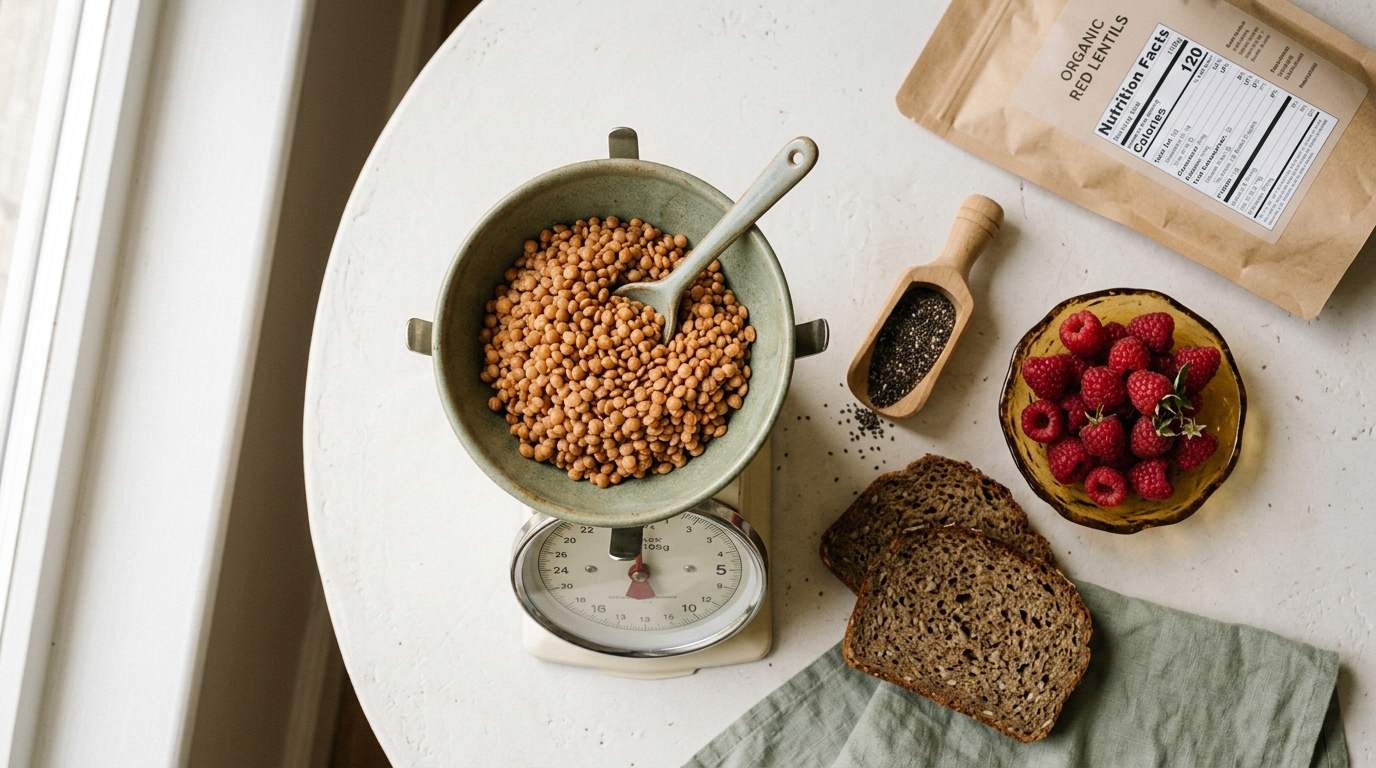
Adults need 28 g of fiber a day on a 2,000-calorie diet. That's the FDA Daily Value printed on every US Nutrition Facts panel, and the average American eats about 16 g. Net carbs are total carbs minus fiber, but that subtraction only works on a US label. EU and UK labels already excluded fiber before printing, so subtracting again wipes 5 to 10 g of carbs off your day.
The rest of this covers mechanics: which number to trust on which panel, what to do about sugar alcohols, how many grams a real portion delivers, and how to log any of it without adding five minutes to every meal.
What 28 grams actually means for you
The 28 g figure is a label reference tied to a 2,000-calorie diet, not a personal target. The underlying recommendation from the National Academies scales with intake: 14 g of fiber per 1,000 calories. Eat 2,600 calories and your number is 36 g. Eat 1,500 and it's 21 g.
European bodies land lower. EFSA calls 25 g/day adequate for adult bowel function, and most national guidelines across the EU sit at 25 to 30 g. The two systems answer different questions rather than contradicting each other. One scales with energy, the other names a floor.
Pick whichever you like and hold it steady for a month. A target you actually measure against beats a better target you keep revising. If you track calories already, the 14 g per 1,000 rule slots in with no extra arithmetic.
Net carbs and the label trap that breaks the formula
Net carbs = total carbohydrate − fiber. That formula is right on a US Nutrition Facts panel, where Total Carbohydrate includes fiber by law. It's wrong on an EU or UK panel, where the carbohydrate line already excludes fiber and lists it separately underneath. Same oats, two labels, a 10 g gap.
Run 100 g of rolled oats through both. The US panel reads Total Carbohydrate 67 g, Dietary Fiber 10 g, so net carbs are 57 g. The EU panel for the identical product reads Carbohydrate 57 g, with Fibre 10 g on its own line. Subtract fiber from that 57 and you get 47 g, and you've deleted 10 g of carbs that you ate.
Telling the panels apart takes two seconds. US labels say "Total Carbohydrate" with "Dietary Fiber" indented beneath it. A European panel says "Carbohydrate" followed by "of which sugars", and fiber sits on a separate unindented line, sometimes on no line at all, since Regulation 1169/2011 makes that declaration voluntary. See the word "Total" and you subtract. No "Total", no subtraction.
This single error causes most net-carb confusion in tracking apps. People import a European product, apply an American formula, and wonder why their carbs run low every day. Restaurant chains complicate it further: a UK menu and its US equivalent will publish different carb figures for the same burrito, and neither is wrong. For the conceptual side, whether fiber has calories at all and why it sits inside the carb column, read how fiber affects your macros.
Sugar alcohols make the arithmetic worse
Polyols carry between 0 and 2.4 calories per gram depending on which one you ate. EU rules give erythritol 0 kcal/g, because roughly 90% of it leaves the body unchanged in urine. Maltitol sits at the other end. Your body absorbs enough of it that treating it as a free carb is wishful thinking.
A workable rule for daily tracking: subtract erythritol in full, subtract half of xylitol, sorbitol and isomalt, and subtract nothing from maltitol. Most low-carb manufacturers follow this convention. It errs toward counting carbs you might not absorb rather than missing carbs you did.
Two practical snags. US panels only declare "Sugar Alcohol" when the product makes a sugar claim, so the line often doesn't appear at all; scan the ingredient list for names ending in -itol instead. Polyol tolerance also varies wildly between people. Some handle 40 g of erythritol without noticing, others bloat at 10 g.
Which foods carry enough fiber to bother logging
Below about 2 g per portion, fiber isn't worth chasing. The foods that move your daily number are legumes, whole grains, berries and a few seeds, and they do it in single portions rather than accumulating across a day of vegetables.
| Food | Realistic portion | Fiber |
|---|---|---|
| Lentils, cooked | 1 cup (198 g) | 15.6 g |
| Avocado | 1 medium (200 g flesh) | 13.5 g |
| Chia seeds | 2 tbsp (28 g) | 9.8 g |
| Raspberries | 1 cup (123 g) | 8.0 g |
| Black beans, canned | ½ cup (86 g) | 7.5 g |
| Pear, with skin | 1 medium (178 g) | 5.5 g |
| Broccoli, cooked | 1 cup (156 g) | 5.1 g |
| Rolled oats, dry | 40 g | 4.0 g |
| Prunes | 5 (42 g) | 3.0 g |
One cup of lentils covers more than half a 28 g target. Add a cup of raspberries and you're at 24 g before lunch. Iceberg lettuce gives you 0.7 g per cup, which is why "eat more salad" rarely closes a fiber gap.
Peel matters more than people expect. An apple loses about a third of its fiber when you skin it, and a peeled potato loses roughly half. If you weigh food anyway, weigh it with the skin on and log it that way.
Ramping up without wrecking your gut
Going from 16 g to 30 g in one day is the classic mistake. Gut bacteria adapt to a fermentation load over one to two weeks, so add about 5 g per day each week: 16, then 21, then 26, then 30. Drink more water as you climb, because soluble fiber pulls water into the bowel.
Bloating in week one is common and usually settles. If it doesn't, or if you have a diagnosed gut condition, talk to a doctor or dietitian rather than pushing through. Some conditions call for the opposite of this advice.
Soluble and insoluble fiber behave differently, and labels don't split them. Oats, beans and psyllium run soluble-heavy; wheat bran and vegetable skins are mostly insoluble. Mixing both across the week works better than loading one type, though no label will tell you the ratio.
How to log fiber day to day
Fiber tracking fails on friction, not on knowledge. Nobody looks up fiber grams for nine ingredients at 8pm. The version that survives a real week is to log the meal once through whatever's fastest and let the app pull fiber from the food record automatically.
MacroLog tracks fiber as one of 12 micronutrients, so it arrives with the entry rather than as a separate step. Scan a barcode and the app pulls fiber from the OpenFoodFacts record alongside calories and macros. Photograph a plate and the AI estimate includes it. Search the 10,000+ food database and it's already attached. Micronutrient tracking, fiber included, belongs to Pro.
Two details that matter in practice. MacroLog flags any meal hitting 20% of a nutrient's Daily Value, so a lentil bowl marks itself as a fiber meal at 5.6 g or more without you checking a number. The app also writes fiber to Apple Health and Google Health Connect as dietary fiber, dropping it in the same place as everything else you measure.
For meals you cook, a saved meal template beats re-entering ingredients. Build your chili once with weighed ingredients, and every future bowl logs its 12 g of fiber in one tap. More on that in counting calories in homemade meals.
FAQ
Do I subtract fiber from carbs on a Polish or German label?
No. EU labels, Polish and German ones included, print carbohydrate with fiber already removed. The number next to "Węglowodany" or "Kohlenhydrate" is your net carb figure as printed. Subtracting the separate fiber line undercounts your carbs.
Does fiber count toward my calorie total?
Partly. The EU assigns fiber 2 kcal/g, the US Atwater system generally treats it as 4 kcal/g inside total carbohydrate, and the real yield from bacterial fermentation runs around 1.5 to 2.5 kcal/g. On 25 g of fiber that disagreement is worth about 50 calories a day, which sits inside the noise of portion estimation.
Should I track net carbs or total carbs?
Total carbs, unless you're doing keto or managing blood sugar with a clinician. Net carbs only matter when a hard carb ceiling drives the diet. For general weight loss, tracking total carbs and fiber separately gives you more information with less arithmetic. See how to count macros step by step.
Is fiber from a supplement the same as fiber from food?
For the carb subtraction, yes. Labels declare psyllium and inulin as fiber, and both behave like it in the arithmetic. For everything else, food-based fiber arrives with potassium, magnesium and polyphenols that a powder lacks. Use supplements to close a gap, not to replace beans.
Why do two apps show different fiber for the same food?
Usually because one entry came from a US label and the other from an EU one, or because a user-submitted entry left fiber blank and the app defaulted it to zero. Barcode-scanned entries from manufacturer data beat crowd entries. Reading nutrition labels properly catches most of these.
Track fiber without the arithmetic
MacroLog logs fiber with every meal on iOS and Android, through barcode, photo, voice or search, and writes it to Apple Health or Health Connect alongside your calories and macros. Download MacroLog and see where your fiber actually lands this week.
