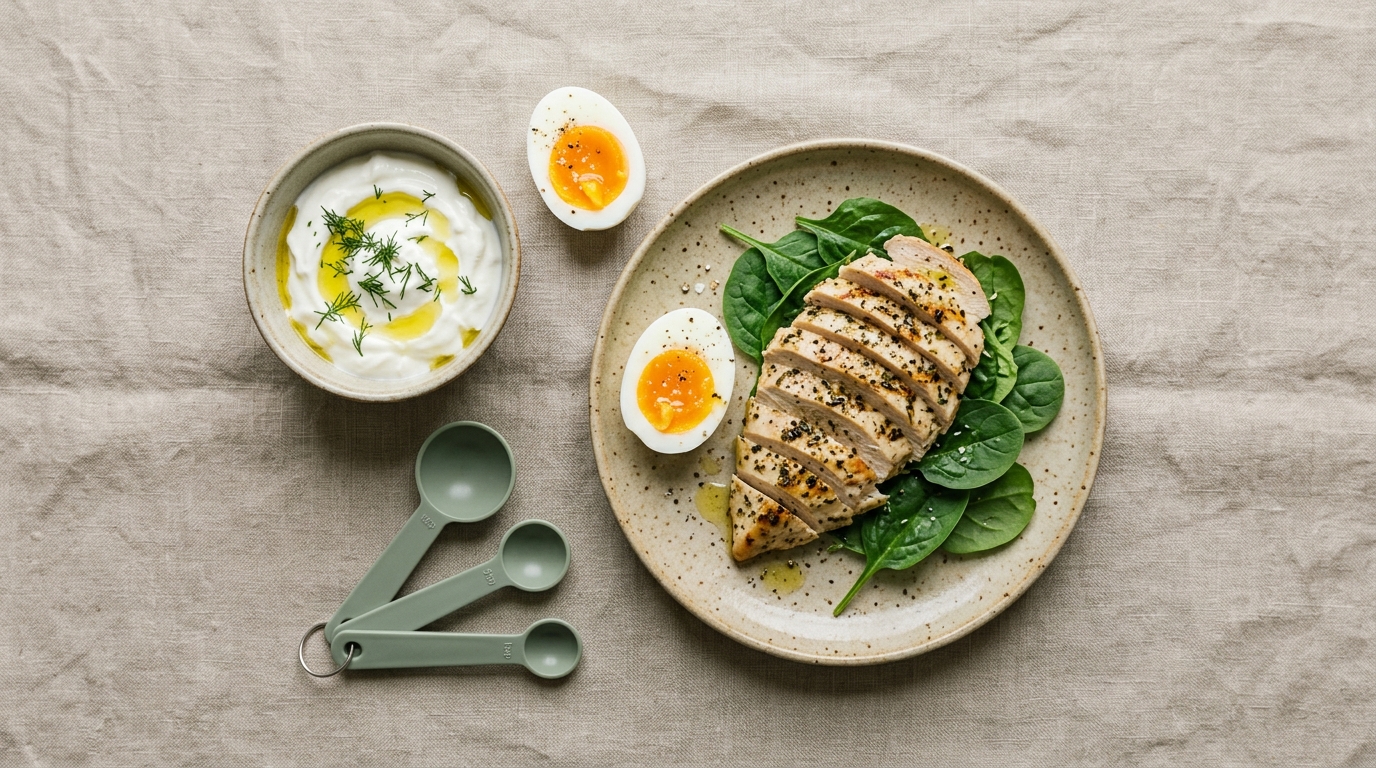
In semaglutide and tirzepatide trials, lean mass made up roughly a quarter to 40 percent of total weight lost among people who did no resistance training and ate ordinary amounts of protein. Two habits change that split: 1.2 to 1.5 grams of protein per kilogram of body weight daily, and lifting something heavy two or three times a week. Your tape measure and your working weights tell you which tissue is leaving.
Nothing below is advice about your medication. Dose, timing, and side effects belong to your prescriber. This is food and training only.
How Much of GLP-1 Weight Loss Is Muscle?
Body-composition data from the large semaglutide and tirzepatide trials puts lean mass at roughly 25 to 40 percent of total weight lost across 68 to 72 weeks. That share sits close to what any fast diet produces without protein and lifting. The drug doesn't single out muscle. The size and speed of the deficit does.
"Lean mass" is wider than muscle. It covers body water, stored glycogen, and the organ and connective tissue that shrink a little whenever a person drops 20 kilos. Some of that loss is normal and harmless. Skeletal muscle is the part worth defending, because it sets your resting energy burn and decides whether you can still carry shopping up two flights at 65.
Run the arithmetic. Lose 20 kg at a 30 percent lean share and about 6 kg of it wasn't fat. Lose the same 20 kg at 15 percent and you keep 3 kg more tissue. That gap shows up two years later, when staying at your new weight depends on how much muscle is still burning calories all day.
How to Tell Muscle Loss from Fat Loss Without a DEXA Scan
No home method separates fat from muscle exactly. Four signals read together get close: your weekly rate of loss, whether your waist shrinks in step with your weight, whether the loads you lift hold steady, and how everyday strength feels. When the scale drops for three weeks and the tape measure barely moves, muscle is going.
- Rate of loss. Above about 1 percent of body weight per week, sustained for a month or more, the lean share of the loss tends to climb. At 100 kg that's a kilo a week.
- Waist versus weight. Measure your waist at the navel every Sunday morning. Two or three weeks of real fat loss show up there. Weight falling while the tape holds flat points at water and lean tissue.
- Working weights. Pick two lifts and record the weight and reps. A 10 to 15 percent drop in what you can move for five reps, with no change in sleep or illness, is a real signal.
- Everyday strength. Jar lids, stairs without the handrail, carrying a full laundry basket. These get harder before any scale notices.
Bioimpedance scales that print a body-fat percentage read hydration more than fat, and GLP-1 medications change how much you drink and how fast your stomach empties. Treat a single reading as noise and the eight-week trend as weak evidence. The same caution applies to daily weigh-ins, which is why the scale lies so often about water weight.
Lever One: Enough Protein, Counted in Grams
Clinicians managing weight loss commonly target 1.2 to 1.5 grams of protein per kilogram of body weight per day, rising toward 2.0 g/kg for people training hard. At 80 kg that's 96 to 120 grams. Fall to around 0.8 g/kg, the general adult minimum, and the lean share of your weight loss goes up.
Here's a worked example. A woman at 95 kg picks the middle of the range, 1.4 g/kg, which gives 133 grams a day. On a GLP-1 she can't eat three large meals, so she splits it four ways at roughly 33 grams each:
- Breakfast: 200 g plain Greek yogurt plus a scoop of whey stirred in — 45 g
- Lunch: 130 g cooked chicken breast — 40 g
- Afternoon: 200 g cottage cheese — 25 g
- Dinner: 120 g salmon with a small side — 25 g
That lands at 135 grams on about 1,400 calories, which leaves room for vegetables, fruit, and some fat. Get your own number from the GLP-1 protein calculator, then check the per-portion figures against high-protein foods ranked by protein per calorie.
One adjustment matters if your BMI is high. Calculating 1.4 g/kg from 140 kg gives 196 grams, which almost nobody can eat with a suppressed appetite. Clinicians often calculate from goal weight or adjusted body weight instead. Ask yours which figure applies to you. The practical tactics for hitting the number when food repels you sit in our guide to how much protein you need on a GLP-1.
Lever Two: Resistance Training Twice a Week
Protein slows lean loss. It doesn't stop it on its own. The signal that tells your body to hold onto muscle is mechanical load, which means lifting weights, bands, or your own body against gravity. Two full-body sessions a week, six to eight hard sets per major movement, covers most people in a deficit.
The goal for these months is defending what you have. Squat or leg press, a hinge, a push, a pull, and something for the calves and core. Keep the loads where they were and add reps only when a set feels genuinely easy. Chasing personal records during a 25 percent deficit usually ends in a stalled week and a sore back.
Walking doesn't count for this. Steps are good for energy balance and mood, and they'll show in the step count your phone already keeps, but strolling never loaded a muscle enough to make your body keep it. If you're new to lifting, have joint or heart conditions, or feel lightheaded on low intake, clear the plan with your doctor first. For what the combination of load and protein can do over a longer run, read our guide to body recomposition.
Already Weeks In and Under-Eating? Start Here
If you've been eating maybe 800 calories a day for six weeks without meaning to, don't overhaul everything on Monday. Measure three ordinary days first, raise protein before you raise anything else, then rebuild the calorie floor. Most people in this position land near 45 grams of protein a day and don't believe it until the log shows them.
- Log three normal days without changing them. Weekday, weekday, weekend. You need a real baseline, not a tidy one.
- Add protein at whichever meal you tolerate best. Usually breakfast, since nausea tends to be lowest early. One 25 to 30 gram addition moves the daily total more than a week of good intentions.
- Bring calories back to a sane floor. Intakes below roughly 1,200 for women and 1,400 for men are hard to make nutritionally complete, and long stretches there are where hair shedding and fatigue start. Take the number to your dietitian or prescriber.
- Start lifting in week two. Two sessions, nothing heroic. Record the loads so you have a baseline to compare against.
- Recheck at four weeks. Waist, working weights, and average daily protein. If protein is up and the tape is moving again, keep going.
Weight regained after a fast loss comes back mostly as fat unless you protect muscle on the way down, which is the main argument for fixing this now rather than at the end.
How to Track It Week to Week
Four numbers are enough: daily protein in grams, waist in centimetres once a week, body weight as a seven-day average, and the load and reps on two lifts. Protein is the one that needs daily attention, because suppressed appetite removes the hunger signal you used to steer by. Everything else is a weekly check.
Guessing protein fails in a specific direction. A chicken thigh that looks enormous on a queasy afternoon often weighs 70 grams and carries 18 grams of protein. Three such days in a row turn a 130 gram target into 90. Weighing food for two weeks recalibrates the eye well enough that estimates get useful afterwards.
MacroLog handles the daily half of that. Log a meal by photo, voice, text description, barcode, or search, and watch the protein bar fill against the goal you set. It also tracks 12 micronutrients and water, records weight with two-way Apple Health and Google Health Connect sync, and works offline on iOS and Android. There's a free tier; AI photo and voice logging sit in Pro. It tracks food and weight, not medication. Your dose and your side effects stay between you and your prescriber.
Frequently Asked Questions
Does Ozempic cause muscle loss?
Not directly. Trial data shows lean mass falling alongside fat during rapid weight loss on semaglutide and tirzepatide, at a share similar to other fast diets. The deficit drives it, and low protein plus no resistance training makes it worse. Speak to your prescriber about anything specific to your treatment.
How do I know if I'm losing muscle or fat without a DEXA scan?
Track waist circumference weekly and the weight you can lift for five reps. Fat loss shrinks the waist. Muscle loss shows up as falling strength while the scale keeps dropping. Neither is precise, but together over four to six weeks they point clearly enough to act on.
Can I build muscle while losing weight on a GLP-1?
Some people can, mostly beginners and people returning after a break. Anyone trained and in a steep deficit should aim to keep what they have. Building generally needs a smaller deficit, protein near the top of the range, and consistent progressive training.
Is 2 grams of protein per kilogram too much?
Research on healthy kidneys finds no harm at around 2.0 g/kg, and most people gain no extra muscle above it. Anyone with kidney disease or on a restricted protein plan needs a number set by their doctor, not by an article.
Can I get muscle back later if I've already lost it?
Yes, though rebuilding takes longer than losing it did. Muscle you trained before returns faster than muscle you never had. Start resistance training now, at whatever weight you can handle, rather than waiting for your weight loss to finish.
What to Do This Week
Pick your protein number, split it across four eating occasions, and book two lifting sessions in your calendar. Measure your waist Sunday morning and write down the loads on two lifts. That's the whole system. When you're ready to stop the medication, keeping weight off after stopping requires the same tracking discipline plus your new maintenance calories.
Then find out where you actually stand. Download MacroLog, log everything for a week by photo or voice, and let the daily protein total tell you whether you're protecting muscle or just watching the scale fall.