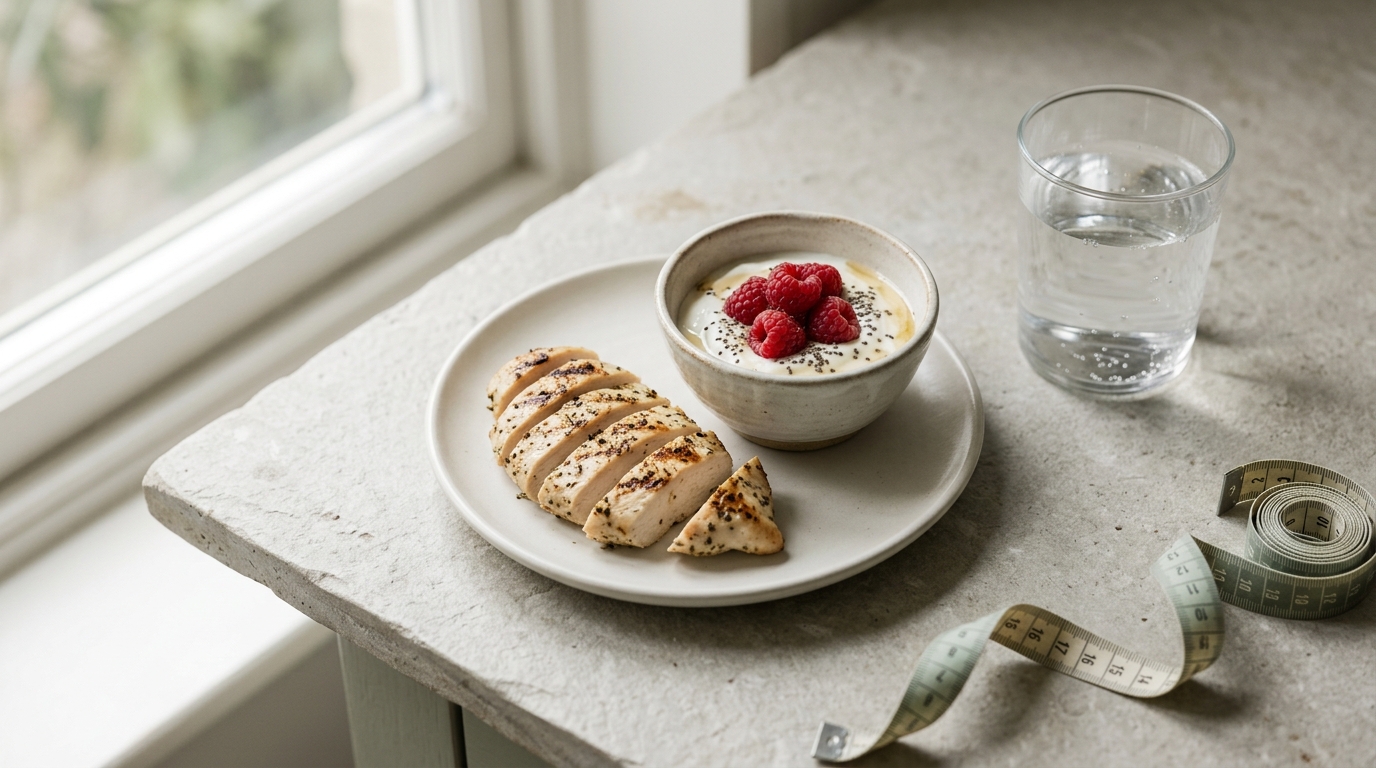
A GLP-1 diet means eating to a shrunken appetite without losing muscle on the way down. Three numbers carry most of it: 1.2 to 1.5 grams of protein per kilogram of body weight daily, 25 to 30 grams of fiber, and 2 to 2.5 litres of fluid. An 80 kg (176 lb) person lands at 96 to 120 grams of protein, usually split across four or five small eating occasions instead of three meals.
Nothing below concerns your dose, your titration schedule, or how to treat side effects. Those belong to your prescriber. Let your prescriber or a registered dietitian set your calorie and protein targets against your medical history.
What the medication changes at the table
GLP-1 receptor agonists slow gastric emptying and quiet the appetite signal. Food sits in the stomach longer, so a plate you cleared easily two months ago now feels like too much halfway through. Hunger stops arriving on schedule. The calorie deficit gets easy; the nutrition inside it gets hard.
That single mechanical change explains almost every eating problem people report. Fullness arrives early, so whatever you put in your mouth first is what you actually ate. Stomach volume, not willpower, now sets the limit, which flips the usual advice about filling up on salad. And because the whole gut slows, not only the stomach, constipation turns up alongside the appetite drop.
Two things stay the same. Energy balance still decides the direction of the scale, and the composition of what you lose still depends on protein and mechanical load. The drug removes the hunger that used to sabotage a deficit. It doesn't decide whether the kilos leaving are fat or muscle.
Protein: the number that dominates everything else
Obesity medicine clinicians commonly cite 1.2 to 1.5 grams of protein per kilogram of body weight per day during rapid weight loss, rising toward 2.0 g/kg for people training seriously. At 90 kg that's 108 to 135 grams. An adult minimum of 0.8 g/kg falls short when you're dropping weight fast, because the lean share of the loss climbs as protein falls.
If your BMI is high, the arithmetic breaks. Calculating 1.4 g/kg from 140 kg gives 196 grams, which nobody eats on a suppressed appetite. Clinicians usually calculate from goal weight or adjusted body weight in that case. Ask yours which figure applies to you, then run it through the protein calculator.
Twenty-five to 30 grams per eating occasion is the working unit. Five of those is 125 to 150 grams, which covers most adults without a single meal ever feeling large. A 170 g pot of nonfat Greek yogurt carries 17 grams for 100 calories, so Greek yogurt does a lot of quiet work in these months.
Our full treatment of the target, worked examples in grams, and what to eat when food repels you sits in how much protein you need on a GLP-1.
Fiber and fluid, in the same breath
Aim for 25 to 30 grams of fiber a day with 2 to 2.5 litres (68 to 85 fl oz) of fluid. Fiber without the fluid makes constipation worse, which is why bran on its own so often backfires. Raise fiber by roughly 5 grams a week rather than jumping from 10 to 30 overnight; the fast version buys cramps.
Some foods do both jobs. Cooked lentils give 8 grams of fiber and 9 grams of protein per 100 g for 116 calories. Chia at 28 g brings 10 grams of fiber, and 125 g of raspberries brings 8 grams for 64 calories. A 2022 trial in Alimentary Pharmacology and Therapeutics found two kiwifruit a day matched or beat psyllium for constipation relief.
Fluid needs deliberate attention now, because thirst fades along with hunger and a slow-emptying stomach makes drinking with meals unpleasant. Sip between meals instead. How fiber fits into your macros shows where fiber grams land in the carb column.
The muscle-loss risk, stated plainly
In the large semaglutide and tirzepatide trials, lean mass made up roughly 25 to 40 percent of total weight lost over 68 to 72 weeks among people who did no resistance training and ate ordinary amounts of protein. Lose 20 kg at a 30 percent lean share and about 6 kg of it wasn't fat.
That share is normal for any fast diet without protein and lifting, and "lean mass" is wider than muscle: it includes water, glycogen, and connective tissue that shrink whenever anyone drops 20 kilos. Skeletal muscle is the part worth defending, because it sets your resting energy burn and decides how maintenance goes two years from now.
Two levers change the split: protein in grams, and two full-body resistance sessions a week. Walking doesn't do this job. For the home signals that tell you which tissue is leaving, without a DEXA scan, read how to tell if you're losing muscle on a GLP-1.
The eating pattern that actually holds
Four or five small eating occasions beat three meals on a GLP-1, and protein goes first at every one of them. Starches and vegetables come last, because fullness now arrives halfway through the plate and whatever you started with is what you got. A rough day still yields 60 to 80 grams from liquid and soft foods.
Run the occasions on a clock. Hunger no longer prompts you, so 8am, 11am, 2pm, 6pm and a small evening item beats waiting for a signal that isn't coming. Each slot needs one anchor food carrying 15 to 30 grams of protein, and the rest can be whatever appeals.
Keep four no-cook items in the house permanently. A ready-to-drink shake at 30 grams for 150 calories, a 150 g pot of skyr at 16 grams, a tuna pouch at 16 grams for 70 calories, boiled eggs at 6 grams each. Cooking motivation drops with appetite, and any plan that assumes two hot meals a day collapses in week two.
Nausea and constipation are eating problems too
Cold, mild, low-fat food goes down when nothing else will, because cold food gives off less smell and fat slows gastric emptying further. A bad day runs on clear whey in cold water, plain Greek yogurt, blended cottage cheese, kefir and bone broth. Persistent symptoms are a conversation for your prescriber, not a menu problem.
The pattern is worth naming. Fried and creamy dishes, fizzy drinks, and large raw salads all tend to sit badly: the first two because of fat and gas, the third because 200 g of leaves and dressing fills a shrunken stomach for 4 grams of protein. No food here is off-limits. Each one simply belongs lower on the plate.
Our GLP-1 food list sorted by the problem each food solves covers all four cases with grams and calories: highest protein per small portion, nausea-day picks, fiber for constipation, and protein that needs no pan.
What happens to intake over the months
Appetite suppression usually deepens over the first months, and intake follows it down without any conscious decision. People routinely land near 800 calories a day and 45 grams of protein while believing they eat normally. That's where hair shedding, fatigue and nutrient gaps start.
Intakes below roughly 1,200 calories for women and 1,400 for men are hard to make nutritionally complete, whatever the source of the appetite loss. Take the number to your dietitian or prescriber. A weight-loss rate above about 1 percent of body weight per week, held for a month, is the other signal that the deficit has run past useful.
Rebuild in order. Measure three ordinary days first, including a weekend. Raise protein at whichever meal you tolerate best, usually breakfast, since nausea tends to be lowest early. Then bring calories back to a floor you can defend.
What maintenance looks like later
Maintenance is where the protein and lifting work pays out. Weight regained after fast loss comes back mostly as fat unless you protect muscle on the way down, so a person who lost 20 kg with 6 kg of it lean tissue faces a harder job than one who lost the same 20 with 3 kg.
The eating habits mostly stay. Protein holds at 1.2 g/kg or above, because that number serves muscle retention rather than appetite. Fiber and fluid hold too. What changes is the calorie ceiling, which rises to whatever keeps your weight steady, and the return of hunger as a usable signal if appetite normalizes.
See body recomposition for what protein plus load can do once the fast loss is over.
Common mistakes that cost muscle
Six errors show up repeatedly, and each carries a cost measured in lean tissue or symptoms. Not one of them concerns the medication itself.
- Letting calories free-fall. Six weeks at 800 calories without noticing is the most common one, and it drags protein down with it.
- Eating the carbs first. Fullness arrives early now, so starting with rice or bread means you never reach the chicken.
- Living on shakes. Liquid protein solves nausea days. Run a whole month that way and fiber and micronutrients both collapse.
- Adding fiber without fluid. A bran supplement into a slow gut on 1 litre a day sharpens constipation instead of fixing it.
- Skipping resistance training. Protein slows lean loss and doesn't stop it alone; mechanical load is the signal that tells the body to keep muscle.
- Guessing portions. A chicken piece that looks enormous on a queasy afternoon often weighs 60 grams and carries 18 of protein. Estimating portions without a scale works, but only after a calibration period.
How to keep the numbers honest
Four figures cover it: daily protein in grams, daily calories, fluid, and waist measured weekly. Protein needs daily attention because suppressed appetite removed the signal you used to steer by. Everything else is a weekly check. Two weeks of weighing food recalibrates the eye well enough that estimates work afterwards.
MacroLog handles the daily half. Log a meal by photo, voice, text description, barcode, or search, and watch protein climb toward the goal you set. It tracks 12 micronutrients and water, syncs weight two ways with Apple Health and Google Health Connect, and works offline on iOS and Android. There's a free tier; AI photo and voice logging sit in Pro.
It tracks food and weight, not medication. MacroLog doesn't know or ask what you take. Your dose, your schedule and your side effects stay between you and your prescriber.
Frequently asked questions
Is there an official GLP-1 diet?
No medication comes with a prescribed menu. What clinicians converge on is a pattern: protein first at 1.2 to 1.5 g/kg, 25 to 30 grams of fiber, enough fluid, and small frequent meals to work around delayed gastric emptying. Your own calorie target should come from your prescriber or dietitian.
How many calories should I eat on a GLP-1?
That number is yours to set with your clinician. One floor is worth knowing: intakes under about 1,200 calories for women and 1,400 for men are difficult to make nutritionally complete, and appetite suppression can push you well below that without you noticing.
Do I need to cut carbs or go keto?
No. Nothing about these medications requires a low-carb approach. In practice protein claims first place on a small plate, so carbs take whatever room is left, and fiber-rich ones like lentils, oats and berries deserve that room. A very low-fiber diet makes the constipation worse.
Can I drink alcohol on a GLP-1 diet?
Nutritionally it spends calories you have little room for, at 7 calories per gram with no protein and no fiber. Whether it fits with your medication is a question for your prescriber, and many people find their taste for it drops on its own.
What should I eat on a day when everything makes me queasy?
Cold, mild and low in fat. Clear whey in cold water, plain Greek yogurt, blended cottage cheese, kefir, bone broth. Take 60 to 80 grams of protein from soft and liquid foods rather than chasing the full target. Don't force a large meal. Report persistent nausea to your prescriber.
What happens to my eating if I come off the medication?
Appetite returning is the change people report most, and the eating habits built during treatment are what carry over. Any decision about stopping belongs to your prescriber. On the food side, protein and resistance training remain the two levers that decide how much of any regain arrives as fat.
Where to start this week
Pick your protein number with your prescriber, split it across four or five slots by the clock, and put one no-cook anchor food in each. Add 5 grams of fiber a week and drink between meals rather than with them. Then measure two ordinary weeks and see how close you actually get.
Download MacroLog, log a few meals by photo or voice, and let the daily protein total tell you whether the plan survived contact with your appetite.


