The health and fitness world is largely built around a standard 9-to-5 schedule. Wake up at 7 AM, eat three meals, hit the gym, and go to sleep by 11 PM. But what happens when your "morning" starts at 9 PM, your lunch break is at 2 AM, and you go to sleep as the sun comes up? For millions of nurses, emergency responders, factory workers, and natural night owls, standard dietary advice falls completely flat.
Mastering shift worker nutrition is one of the most challenging aspects of maintaining a healthy lifestyle. The erratic hours disrupt your circadian rhythm, mess with your hunger hormones, and make conventional calorie tracking apps incredibly frustrating to use. If you have ever felt defeated because your app reset your daily log right in the middle of your "day" at midnight, you are not alone.
In this comprehensive guide, we will explore the science of how irregular hours affect your metabolism, practical strategies for logging your food, and how to stay in a healthy energy balance regardless of what the clock says.
The Science Behind Shift Work and Metabolism
Before diving into the logistics of tracking, it is crucial to understand what is happening inside your body when you work nights. Human beings are diurnal creatures, meaning our biology is optimized for daytime activity and nighttime rest. This internal clock, known as the circadian rhythm, dictates the release of hormones like melatonin (which makes you sleepy), cortisol (which wakes you up), and insulin (which regulates your blood sugar).
When you stay awake and eat during the night, you are fighting millions of years of evolutionary programming. Studies show that nighttime eating often leads to decreased insulin sensitivity. This means your body has to work harder to process carbohydrates at 3 AM compared to 1 PM. Furthermore, sleep deprivation—a common side effect of shift work—spikes ghrelin (the hunger hormone) and suppresses leptin (the fullness hormone), making you crave high-calorie, sugary foods. Sleeping through the day adds its own hurdle, since traffic and household noise peak just as you go to bed. Earplugs or a steady fan can mask much of it, and this guide to how noise affects sleep explains when background sound helps and when it does not.
However, despite these hormonal hurdles, the fundamental laws of thermodynamics still apply. As explained in our article on , weight loss or gain ultimately comes down to calories in versus calories out. You can absolutely achieve your fitness goals while working shifts; you just need a more strategic approach to your energy intake.
The Midnight Reset: How to Track When Your Day Crosses Over
The most common frustration for shift workers trying to track their food is the midnight reset. Most apps automatically close out your day at 11:59 PM. If your shift is from 10 PM to 6 AM, half of your meals are logged on Tuesday and the other half on Wednesday. This makes it incredibly difficult to see your true daily totals. If you are new to tracking, you should first check out How to Count Calories: The Complete Beginner's Guide, but here are two specific strategies for shift workers to handle the midnight crossover:
Strategy 1: The Waking Day Method
This is the most intuitive method for night shift workers. You simply log all the food you eat from the moment you wake up until the moment you go to sleep under a single calendar day, regardless of what the actual date is.
- Example: You wake up at 4 PM on Tuesday. You log your "breakfast" at 5 PM, your "lunch" at midnight, and your "dinner" at 6 AM on Wednesday morning. You log all of these meals under Tuesday in your app.
- Pros: It keeps your daily macro and calorie totals in one easy-to-read view, mimicking a normal day.
- Cons: You have to remember to manually change the date in your app if you are logging a meal after midnight.
Strategy 2: The 24-Hour Rolling Window
If you work rotating shifts (e.g., two days, two nights, two off) and your sleep schedule is constantly changing, the Waking Day Method might become too confusing. Instead, treat your calorie target as a weekly average or use a strict 24-hour window (e.g., Midnight to Midnight).
With this method, you don't worry about "breakfast" or "dinner." You simply eat when you need to, and ensure that over a 7-day period, your total calories align with your goals. To calculate these goals, use a TDEE calculator.
Macronutrients for the Night Shift
When it comes to shift worker nutrition, what you eat is just as important as how much you eat. Because your digestion slows down at night and your insulin resistance is temporarily higher, you need to be smart about your macronutrient distribution. If you need a refresher on macros, read .
1. Prioritize Protein for Alertness
Protein is your best friend on a night shift. Not only does it keep you full, but protein-rich foods stimulate the production of dopamine and norepinephrine, neurotransmitters that promote alertness and focus. Aim for lean meats, Greek yogurt, or a protein shake during your main shift break.
2. Be Strategic with Carbohydrates
Heavy, carb-dense meals (like a massive bowl of pasta or a large pizza) can cause a massive spike in blood sugar followed by a crash. At 3 AM, this crash will make you feel incredibly lethargic. Save your larger carbohydrate portions for the end of your shift, right before you go home to sleep. Carbs can actually help induce sleepiness by facilitating the entry of tryptophan into the brain. During your shift, stick to high-fiber, complex carbs like berries or vegetables.
3. Keep Fats Moderate
Fats are essential for hormone health, but they also slow down digestion. A high-fat meal in the middle of the night can lead to acid reflux, bloating, and sluggishness. Learn more about balancing your fat intake in our guide: How Much Fat Should You Eat Per Day? The Ultimate Guide.
Common Pitfalls in Shift Worker Nutrition
Working irregular hours presents unique environmental challenges that can easily derail your calorie deficit. Being aware of these traps is the first step to avoiding them.
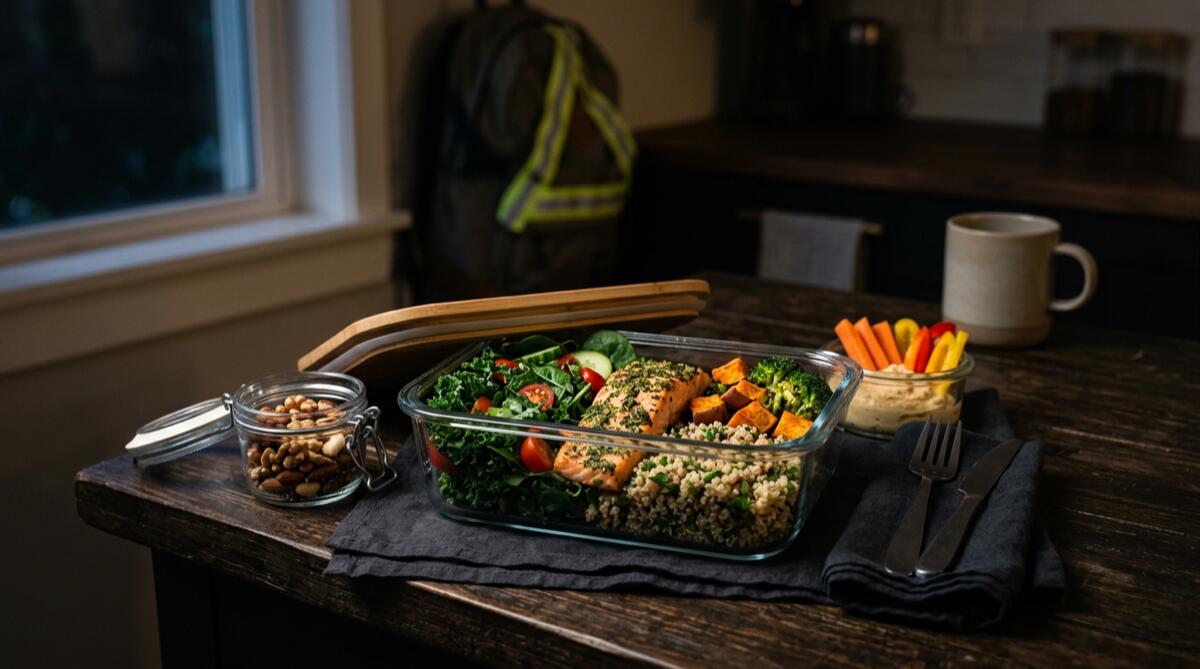
- The Vending Machine Trap: At 3 AM, the hospital cafeteria or factory canteen is usually closed. The only options left are vending machines filled with chips, candy bars, and sugary energy drinks. Solution: Always bring your own food. Meal prep is non-negotiable for successful shift workers.
- Fatigue-Induced Bingeing: When you are exhausted, your brain seeks quick energy in the form of sugar. You might find yourself mindlessly snacking just to stay awake. If you struggle with this, read Why Your Calorie Count Is Wrong (And How to Fix It) to see how untracked "bites and licks" add up.
- Liquid Calories: Coffee is a night worker's lifeblood. But if you are drinking four lattes loaded with syrup and whole milk, you could be consuming hundreds of hidden calories. Stick to black coffee, zero-calorie energy drinks, or tea.
How MacroLog Makes Shift Work Nutrition Easier
When you are coming off a 12-hour shift, your brain is fried. The last thing you want to do is manually search for foods, weigh ingredients, and do math to calculate your macros. This is where MacroLog becomes an absolute game-changer for shift workers.
MacroLog is an AI-powered calorie tracking app designed to remove the friction from logging your food. Here is how it specifically helps those on irregular schedules:
- AI Voice Logging: Exhausted after a long shift? Just open the app and say, "I had two scrambled eggs, a slice of whole wheat toast, and a black coffee." MacroLog's AI instantly understands, calculates the calories and macros, and logs it for you.
- Photo Recognition: Eating a pre-packaged meal in a dimly lit breakroom? Just snap a photo of your food. The AI will analyze the image, estimate the portion size, and log the nutritional data.
- Barcode Scanning: If you do have to rely on a protein bar from the vending machine, the lightning-fast barcode scanner ensures you log it accurately in seconds.
By automating the tedious parts of calorie counting, MacroLog helps you maintain consistency, which is the true secret to results.
Calculating Your Calorie Needs on an Irregular Schedule
Your Total Daily Energy Expenditure (TDEE) can fluctuate wildly when you work shifts. On a day shift, you might be highly active. On a night shift, you might be sitting at a desk, followed by a day of sleeping and minimal movement. So,
For shift workers, it is often best to calculate your baseline needs using the Mifflin-St Jeor Equation with a "Sedentary" activity multiplier. Then, you can use your app or a smartwatch to track your active calories on days you work and eat slightly more to compensate. Alternatively, you can set a weekly calorie goal rather than a strict daily one. If your goal is to lose weight, understanding the mechanics of energy balance is crucial. Check out to set your targets correctly.
Conclusion: Consistency Over Perfection
Perfect shift worker nutrition does not exist. There will be nights when you forget your meal prep, nights when you are too tired to eat, and mornings when you just want a massive breakfast before crashing into bed. The goal is not perfection; it is consistency.
By understanding your body's hormonal responses, strategically timing your macronutrients, and using smart tools to reduce the mental load of tracking, you can absolutely achieve your health and fitness goals while working outside the 9-to-5 norm. To see how a science-based approach can transform your results, read .
Ready to take control of your nutrition, no matter what time your alarm goes off? Stop fighting with clunky apps that don't understand your schedule. Download MacroLog today and let AI do the heavy lifting for you, so you can focus on your work, your health, and getting that much-needed rest.

