The Freedom of Visual Estimation
Imagine this: you are at a beautiful restaurant, the ambiance is perfect, your friends are laughing, and the waiter sets down a mouth-watering plate of food. Are you really going to pull out a digital food scale from your bag? Probably not. Learning how to estimate food portions is a crucial life skill for anyone interested in maintaining a healthy lifestyle without being tethered to their kitchen counter.
While weighing your food is the most accurate way to track your intake, it is not always practical. Whether you are traveling, dining out, or simply exhausted after a long day of work, relying solely on a food scale can lead to tracking fatigue. This is exactly why mastering a reliable portion size guide is the secret to long-term dietary success.
The Psychology of Portion Distortion
Before we dive into the practical methods of estimating food, we need to understand a phenomenon known as "portion distortion." Over the last few decades, standard plate sizes in restaurants and homes have grown significantly. A standard dinner plate in the 1980s was about 9 inches in diameter; today, it is often 12 inches or more.
Because our brains rely on visual cues to determine how much we should eat, a normal portion of food on a massive plate looks like a tiny, unsatisfying amount. This optical illusion causes us to serve ourselves more food than we actually need. Understanding this is the first step in fixing why your calorie count is wrong. By learning to measure food against objective markers—like your hands or everyday objects—you bypass the plate-size illusion entirely.
Why You Need a Reliable Portion Size Guide
Weight loss, weight gain, or weight maintenance all come down to energy balance. If you want to lose weight, you need to be in a calorie deficit. (You can learn more about this in our comprehensive guide on what a calorie deficit is and how it works). However, if you are guessing your portions blindly, you might be eating hundreds of extra calories a day without realizing it.
For example, a standard serving of peanut butter is two tablespoons (about 32 grams), which contains roughly 190 calories. But a "heaping" spoonful straight from the jar can easily be double that amount. A good portion size guide helps you bridge the gap between strict weighing and blind guessing, allowing you to stay on track accurately enough to see results.
The Hand Method: Your Built-In Food Scale
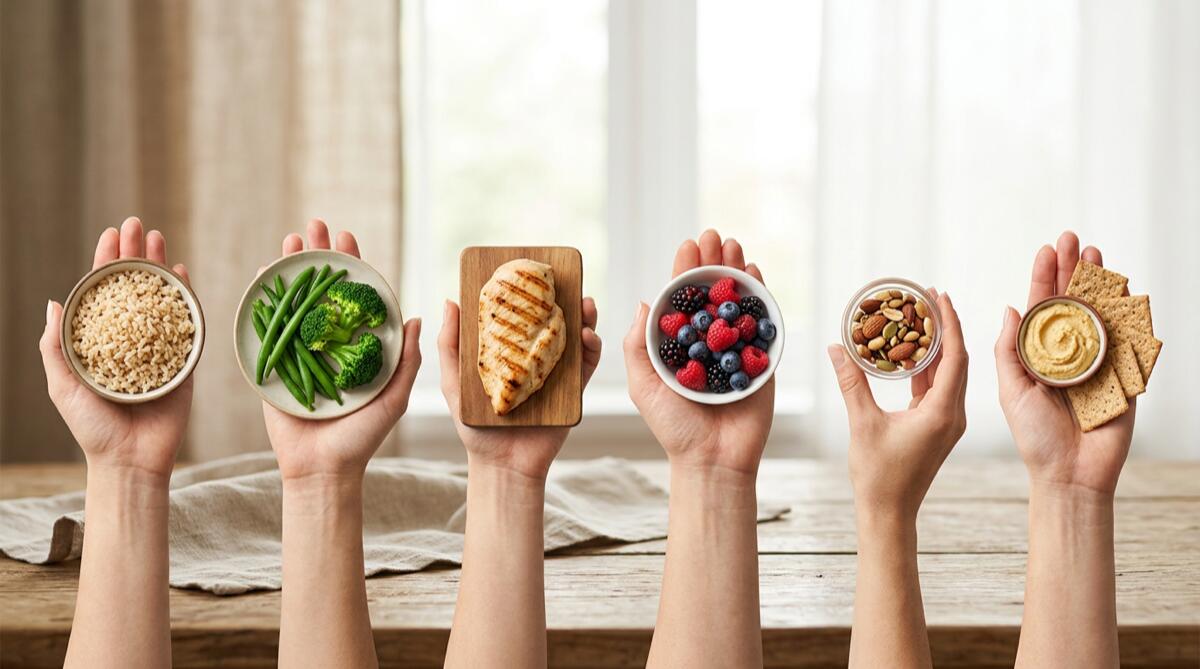
The most popular and practical portion size guide is the "Hand Method." Why? Because your hands are always with you, and they scale perfectly with your body size. Larger people generally need more food and have larger hands, while smaller people need less food and have smaller hands. Here is how to break down your macronutrients using just your hands.
1. Protein: The Palm of Your Hand
For protein-dense foods like chicken breast, beef, fish, tofu, or Greek yogurt, use the palm of your hand as a guide. One palm-sized portion (excluding your fingers and thumb) is roughly equivalent to 3-4 ounces (85-115 grams) of cooked meat, which provides about 20-30 grams of protein.
- Men: Generally aim for two palm-sized portions per meal.
- Women: Generally aim for one palm-sized portion per meal.
2. Carbohydrates: Your Cupped Hand
Carbohydrate sources like rice, pasta, potatoes, oats, and beans can be tricky to estimate. Use your cupped hand to measure these. One cupped hand represents about 1/2 cup of cooked grains or starches, which is roughly 20-30 grams of carbohydrates and 100-150 calories depending on the food.
- Men: Aim for two cupped hands of carbs per meal (if active).
- Women: Aim for one cupped hand of carbs per meal.
3. Vegetables: Your Fist
When it comes to non-starchy vegetables like broccoli, spinach, carrots, and peppers, use your closed fist. One fist is roughly equal to one cup of vegetables. Since these are low in calories and high in micronutrients, estimating them doesn't need to be perfectly precise, but aiming for 1-2 fist-sized portions per meal is a great habit for overall health and satiety.
4. Fats: Your Thumb
Fats are the most calorie-dense macronutrient, making them the easiest to overeat. Use your entire thumb (from the base to the tip) to estimate portions of liquid oils, butter, peanut butter, or cheese. One thumb-sized portion is about 1 tablespoon, which equates to roughly 7-14 grams of fat. To understand exactly how these fit into your daily goals, check out our guide on how much fat you should eat per day.
The Everyday Object Method
If the hand method doesn't resonate with you, comparing food to everyday objects is another excellent portion size guide. This is especially helpful when looking at a plate of food someone else has prepared.
- A Deck of Cards: Roughly 3 ounces of meat, poultry, or fish.
- A Tennis Ball: About 1 medium piece of fruit (like an apple or orange) or 1 cup of pasta/rice.
- A Baseball: Roughly 1 cup of leafy greens or a large potato.
- 4 Dice: About 1 ounce of cheese.
- A Golf Ball: Roughly 2 tablespoons of salad dressing, peanut butter, or hummus.
- A Poker Chip: About 1 tablespoon of olive oil or mayonnaise.
Estimating Mixed Meals and Takeout
Estimating a plain chicken breast and a side of rice is one thing, but what happens when you order a slice of pizza, a bowl of chili, or a massive burrito? Mixed meals are notoriously difficult to estimate because the macros are blended together.
When faced with a mixed meal, the best strategy is to visually deconstruct it. Look at your burrito and ask yourself: How many cupped hands of rice are in here? How many palms of meat? How many thumbs of cheese and guacamole? Break the meal down into its core components and estimate them individually.
This is where modern technology becomes a game-changer. With MacroLog, you don't even have to do the mental gymnastics. MacroLog features advanced AI photo recognition. Simply snap a picture of your mixed meal, and the AI will analyze the image, identify the components, and estimate the portion sizes and calories for you. It takes the stress out of dining out and makes visual estimation effortless.
Beware of Liquid Calories and Hidden Fats
The biggest pitfalls in any portion size guide are the things you can't easily see: cooking oils, butter, heavy cream, and sugary beverages. A beautifully estimated salad can quickly turn into a 800-calorie meal if it's drenched in an unmeasured dressing.
When estimating food at restaurants, always assume there is more fat than you think. Restaurants use generous amounts of butter and oil to make food taste incredible. A good rule of thumb when eating out is to add 1-2 "thumbs" (tablespoons) of fat to your mental estimate to account for cooking oils.
Combining Estimation with Technology
We live in an era where you don't have to choose between strict, obsessive weighing and completely blind eating. You can find a healthy middle ground. If you want to learn more about this balance, read our article on how to track calories without becoming obsessive.
Using an intelligent app like MacroLog perfectly complements your visual estimation skills. If you are at a family BBQ and you estimate you ate a palm-sized burger patty and a fist of potato salad, you can simply use MacroLog's voice logging feature. Just say, "I ate a medium beef burger patty and a cup of potato salad," and the AI will instantly log the correct macros and calories. No searching through endless databases, no manual typing.
Furthermore, for packaged foods that you are estimating portions from, MacroLog's rapid barcode scanner allows you to scan the item, enter the fraction of the package you ate (e.g., "half the bag"), and immediately get back to enjoying your life.
How to Calibrate Your Eyes
Visual estimation is a skill, and like any skill, it requires practice. You won't be perfect on day one. The best way to become highly accurate at using a portion size guide is to "calibrate your eyes" at home.
For one week, guess the weight of your food before you put it on the scale. Serve yourself what you think is a cupped hand of rice, guess the weight, and then weigh it. You will quickly discover your personal blind spots. Maybe you are great at estimating chicken, but you constantly underestimate pasta. By testing your visual estimates against a real scale in the comfort of your home, you will build immense confidence for when you have to estimate food in the real world.
Conclusion
Ditching the food scale doesn't mean giving up on your health and fitness goals. By understanding portion distortion, utilizing the hand method, referencing everyday objects, and being mindful of hidden fats, you can accurately manage your diet anywhere in the world.
Combine these visual skills with the power of AI, and you have an unbeatable strategy for long-term success. Ready to make calorie tracking effortless? Download MacroLog today and experience the future of nutrition tracking with AI photo recognition, voice logging, and smart barcode scanning. Your diet should fit your lifestyle, not the other way around.


