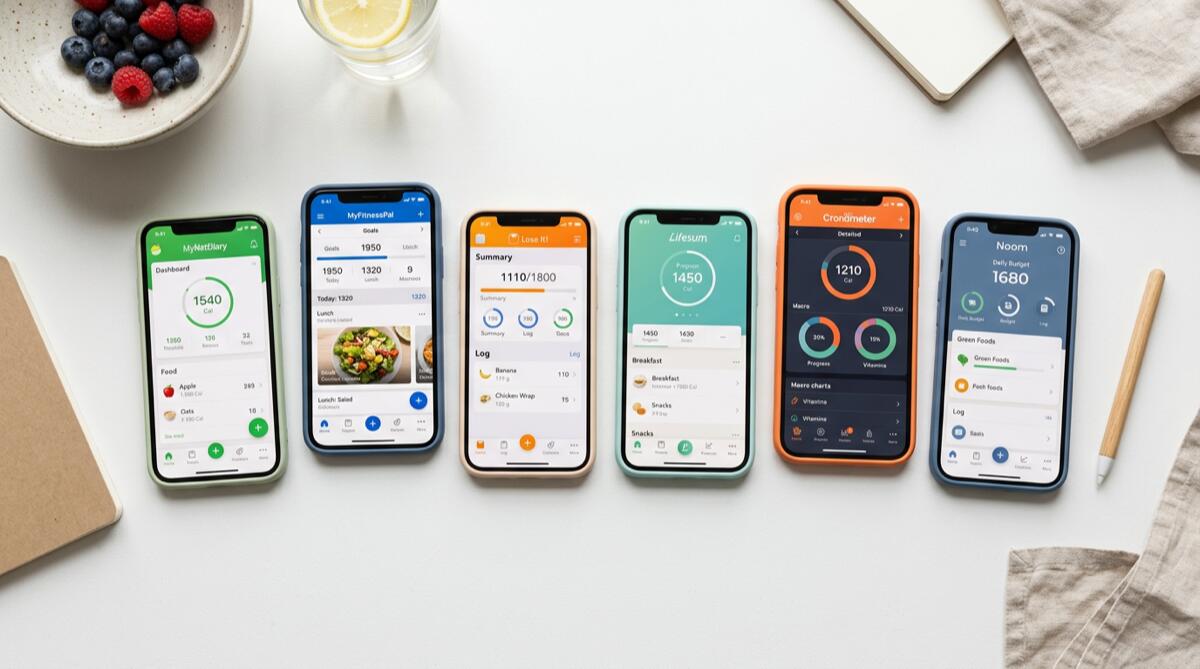
MacroLog is the calorie counter to try first in 2026 if you want unlimited barcode scanning on a free tier, a diary that keeps working with no connection, and no account to create: the packaged lunch is a scan, and the restaurant plate or the home-cooked dinner is a photo or a spoken sentence on Pro. Choose MyFitnessPal if most of your calories come from restaurants, Lose It! if groups and challenges are what keep you logging, Cronometer if you want staff-reviewed food data, or MacroFactor if you want your calorie target recalculated for you every week.
Disclosure: MacroLog is our app and we have put it first, which is the bias you should expect from a company listicle. Every competitor fact below is attributed to that app's public Google Play listing, checked August 12, 2026, so you can verify it yourself; the judgements about fit are ours. MacroLog claims are checked against our internal product-facts ledger. No prices appear here on purpose — they vary by country and promotion, and a number in an article is out of date within weeks.
Counting calories fails for boring reasons: the packaged lunch takes four taps, the restaurant plate is a guess, and the home-cooked dinner is not in any database. So this list is ordered by how each app handles those three situations and what its free tier actually includes — not by download counts. If your real question is protein rather than calories, read the best macro tracking apps in 2026 instead; that list weighs the same five apps on macro features.
The shortlist
| App | Best for | The one thing that decides it |
|---|---|---|
| MacroLog | Logging fast without an account | Photo, barcode, voice, or search, and no sign-up screen |
| MyFitnessPal | Restaurant and branded food | 20.5M+ foods and 40+ device and app integrations |
| Lose It! | Accountability from other people | Friends, groups, and challenges in the free tier since 2008 |
| Cronometer | Knowing where the numbers came from | 95+ nutrients on a staff-reviewed 1.1M-food database |
| MacroFactor | Targets that follow your weight trend | Weekly recalculated expenditure and calorie plan |
1. MacroLog — four ways to log, no account
MacroLog is a calorie and macro tracker for iPhone, iPad, and Android. The packaged lunch is a barcode scan, and that is free and unlimited. The restaurant plate or the home-cooked dinner is a photo or a spoken sentence — both Pro features, and both end in a review step where the app proposes the food and the grams and you confirm or correct them. Treat a photo estimate as an informed guess rather than a measurement; a barcode reads the printed label instead of estimating.
Your calorie target comes from the Mifflin-St Jeor equation for BMR and TDEE, adjusted for your activity level and whether you want to lose, maintain, or gain, and you can overwrite it. Steps and active energy are read from Apple Health or Health Connect for display only: walking more never quietly raises the budget you are trying to stay under. Every calorie sits next to its protein, carbs, and fat, with 12 micronutrients, water, and weight in the same diary on Pro.
Two things make it unusual rather than just another counter. There is no sign-up screen — you set goals and start logging, and the diary lives in a local database on the phone; multi-device sync and cloud backup are planned. And the diary, your history, and the on-device food list keep working with no connection, so a flight or a basement restaurant does not stop you logging; AI photo, voice, and barcode lookups do need a connection.
Limitations, plainly: in-app search covers 10,000+ foods, not millions, and barcode data comes from OpenFoodFacts, which is community-maintained. There is no coaching, no meal plans, no fasting timer, no exercise logging, and no medication tracking. Integrations stop at Apple Health and Health Connect — no Fitbit, Garmin, Whoop, Oura, or Samsung Health. There is no web or Mac logging: iPhone, iPad, and Android only.
Download MacroLog, or read the head-to-head comparisons: vs MyFitnessPal, vs Lose It!, vs Cronometer, vs MacroFactor.
2. MyFitnessPal — the database, if you eat out
Its Google Play listing claims 20.5M+ foods including restaurant dishes, 40+ tracker and app integrations, Wear OS support, and a community, and it now describes GLP-1 medication logging with reminders and symptom tracking. Barcode scan, meal scan, and voice logging are listed as Premium features.
Pick MyFitnessPal over MacroLog if most of your calories come from restaurants and branded products, or if you want a Fitbit or Garmin feeding the same app, or if you want your medication in the food diary — MacroLog tracks food only and does not ask what you take. The trade is that the free tier does not include the barcode scanner. Full comparison.
3. Lose It! — when other people keep you honest
Running since 2008, its listing claims 56M+ items and recipes and puts calorie tracking, a weight-loss plan, and community support in the free tier. Photo logging, AI voice, the barcode scanner, macro and micronutrient tracking, fasting, and meal planning sit under Premium, along with blood pressure, glucose, sleep, and body measurements. Its listing also describes medication logging with estimated GLP-1 levels by phase.
Pick Lose It! over MacroLog if challenges and groups are what make you keep logging, or if you want one app holding food alongside sleep, glucose, and measurements. MacroLog has no social features at all, by design. Full comparison.
4. Cronometer — when you care where the numbers came from
Its listing describes a curated database of 1.1M+ foods including NCC-analysed entries, with corrections reviewed by staff rather than applied directly by users, plus 95+ nutrients and compounds. Barcode scanning is free; AI photo and voice logging, the fasting tracker, and custom charts are Gold. Fitbit, Garmin, Oura, WHOOP, Dexcom, Health Connect, and Wear OS all appear in the listing.
Pick Cronometer over MacroLog if a community-editable food entry bothers you, or if the reason you are counting calories is really iron, B12, or potassium. MacroLog's 12 micronutrients on Pro are enough to spot a fiber or sodium pattern, not enough to audit a diet. Full comparison.
5. MacroFactor — when you want the target to move for you
Its listing describes a nutrition coach that recalculates your energy expenditure from your logged intake and your weight trend, then updates your calorie and macro plan weekly — explicitly without warnings, red numbers, or shaming, and regardless of how closely you hit the target. Logging is search, barcode, custom foods, and smart history; there is no photo or voice path, and its listing states there is a free trial but no free version.
Pick MacroFactor over MacroLog if you weigh in regularly, log consistently, and want your calorie target to follow the data instead of a formula. MacroLog leaves your goal where you set it until you change it. Full comparison.
Comparison table
| MacroLog | MyFitnessPal | Lose It! | Cronometer | MacroFactor | |
|---|---|---|---|---|---|
| Account required | No | Yes | Yes | Yes | Yes |
| Barcode scanning | Free, unlimited | Premium | Premium | Free | Included |
| Photo logging | Yes (Pro) | Yes (Premium) | Yes (Premium) | Yes (Gold) | No |
| Voice logging | Yes (Pro) | Yes (Premium) | Yes (Premium) | Yes (Gold) | No |
| Macros beside calories in the free tier | Yes | Yes, custom targets are Premium | Premium | Yes | No free tier |
| Food database | 10,000+ in-app, OpenFoodFacts barcodes | 20.5M+ foods | 56M+ items and recipes | 1.1M+ curated foods | Large verified database plus Open Food Facts |
| Micronutrients | 12 (Pro) | Custom nutrient targets | Premium | 95+ nutrients and compounds | Yes |
| Diary works with no connection | Yes | Not described in the listing | Not described in the listing | Not described in the listing | Not described in the listing |
| Medication tracking | No | Yes | Yes | No | No |
| Free tier | Yes | Yes, with ads | Yes, with ads | Yes, with ads | No, trial only |
Every column except MacroLog's comes from that app's Google Play listing on August 12, 2026. Tiers and feature gating change often, so check the current listing before you pay for anything.
Set your calorie target before you install anything
Whichever app you pick, the number it starts you on comes from a formula you can run yourself in a minute. Our TDEE calculator gives you maintenance calories, the calorie deficit calculator turns that into a target, and the macro calculator splits it into protein, carbs, and fat. If the arithmetic interests you, the Mifflin-St Jeor equation explained shows where every one of those numbers comes from, and how to count calories covers the habit itself.
Sources checked August 12, 2026
- Official Google Play listings for MyFitnessPal, Lose It!, Cronometer, and MacroFactor — database sizes, free versus paid feature gating, integrations, medication features.
- MacroLog claims: internal product-facts ledger and the live Google Play and App Store listings.